Gemini Flashエージェントがミシガン州の酪農家を支援How Gemini Flash agents are helping a Michigan dairy farmer
匿名の公開いいねです。記事の保存・お気に入りではなく、Featured、Top 3、重要度、掲載順位には影響しません。仕組みとプライバシーAnonymous public likes are reactions, not saved articles or bookmarks. They do not affect Featured, Top 3, importance, or listing order.How it works and privacy
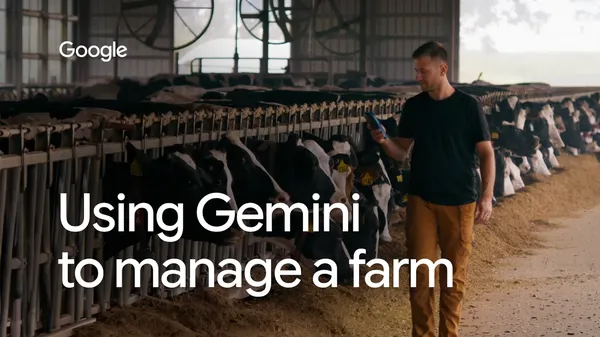
ミシガン州の酪農家Paul WindemullerがGemini 3.6 Flashで構築したAIエージェントを農場管理に活用し、業務効率を大幅に改善している事例が紹介された。
Michigan dairy farmer Paul Windemuller is using AI agents built with Gemini 3.6 Flash to streamline farm management, showcasing a real-world agricultural use case for Google's latest model.
本ページの本文と要約は AI による自動生成です。日本語版と英語版は言語ごとに独立して生成されるため、表現や詳しさが異なる場合があります。正確性は元記事 (blog.google) をご確認ください。The body and summaries are AI-generated independently for each language, so wording and detail may differ. Verify accuracy at the original source (blog.google).
要約と収集メタデータに基づく AI 解説。元記事全文の転載・翻訳ではありません。AI explainer based on the summaries and collected metadata, not a copy or translation of the full source article.
Googleは公式ブログで、米ミシガン州の酪農家であるPaul Windemuller氏が、生成AIモデル「Gemini 3.6 Flash」で構築したAIエージェントを農場管理に取り入れ、日々の業務を効率化している事例を紹介した。大規模言語モデルを現場作業の多い農業分野に応用した実例として注目される。
AIエージェントとは、ユーザーの指示に基づき情報の収集や整理、判断の補助といった一連の作業を自律的にこなすソフトウェアを指す。従来のチャット型AIが質問への回答を返すのに対し、エージェントは複数の手順をまたいでタスクを進められる点が特徴とされる。Windemuller氏の事例では、こうしたエージェントを酪農経営の実務に組み込むことで、これまで手間のかかっていた作業を軽減していると見られる。
今回用いられたGemini 3.6 Flashは、GoogleのマルチモーダルAI「Gemini」シリーズのうち、応答速度と処理コストの軽さを重視した「Flash」系統に位置づけられるモデルとされる。軽量モデルは大量の処理を素早くこなす用途に向くとされ、現場での実用を想定したエージェント構築との相性がよいと考えられる。
農業分野では近年、収穫量の予測や家畜の健康管理、作業の自動化などにAIを活用する動きが世界的に広がっている。GoogleのほかにもMicrosoftやスタートアップ各社が農業向けのデータ解析ツールを手がけており、大手クラウド事業者にとって農業は生成AIの実地応用を示す舞台の一つとなっている。今回の紹介も、最新モデルの現実世界での使い道を示す狙いがあると見られる。
一方で、こうした事例はあくまで個々の農家の取り組みを紹介したものであり、酪農全般への効果や導入に必要なコスト、技術知識などは環境によって異なる可能性がある。同様の成果がどの程度まで一般化できるかは、今後の導入事例の広がりを見極める必要があるだろう。
Google has spotlighted a practical example of its Gemini Flash technology at work outside the usual technology sector, profiling a Michigan dairy farmer who has built AI agents to help run his operation. The case matters because it illustrates how so-called agentic AI is beginning to reach hands-on, traditionally non-digital industries rather than remaining confined to software development and office productivity.
According to the source material published on Google's Keyword blog, Paul Windemuller, a dairy farmer in Michigan, is changing the way he works by using AI agents built with Gemini 3.6 Flash. The stated goal is to streamline farm management, and the profile is presented as a real-world showcase for Google's latest model rather than as a formal product announcement. Specific details about which daily tasks the agents handle are limited, so the exact scope of the deployment should be read as an illustrative example.
Gemini Flash is the lighter, faster tier within Google's Gemini family of models. It is generally positioned as a lower-latency, more cost-efficient option than the larger Gemini Pro or Ultra variants, designed for high-volume tasks where speed and price matter more than maximum reasoning depth. That trade-off appears well suited to a small business setting like a farm, where a user is likely to run many routine queries and automated steps rather than a handful of complex, compute-heavy requests. The reference to "Gemini 3.6 Flash" indicates an iteration of that model line being used in this deployment.
The term "AI agents" is central to understanding the story. An agent, in this context, typically refers to a system that can go beyond answering a single question and instead take a sequence of actions toward a goal, such as retrieving data, calling external tools or services, and returning a structured result. For a dairy operation, that could plausibly involve organizing records, summarizing information, or automating repetitive administrative work, though the source does not enumerate the specific workflows. The broader significance is that a farmer, rather than a professional engineer, is described as building these agents, which points to the trend of AI development becoming more accessible to non-specialists.
This profile fits within a wider industry push toward agentic AI throughout 2025 and 2026. Google has been building out developer tooling around this idea, including infrastructure on its Vertex AI platform and frameworks intended to help people assemble agents that connect models to real data sources. Competitors have moved in parallel: OpenAI, Anthropic, and Microsoft have all promoted agent-style capabilities, and shared standards such as the Model Context Protocol have emerged to help AI systems interact with outside tools and databases in a more consistent way. A farm-management example serves as a concrete, relatable demonstration of capabilities that are otherwise often explained in abstract technical terms.
It is also worth situating this within the longer history of technology in agriculture. Precision agriculture, which uses sensors, GPS-guided equipment, and data analytics to manage crops and livestock more efficiently, predates the current wave of generative AI. Dairy farms in particular have adopted automated milking systems, herd-monitoring hardware, and record-keeping software over the past two decades. Large language models and agents represent a newer layer that could, in principle, sit on top of this existing data and make it easier to query and act upon in plain language, lowering the technical barrier for farmers who are not database experts.
Readers should treat the account as a vendor-published customer story, which means it is intended in part to demonstrate the value of Google's products. It does not include independent metrics, pricing for the specific setup, or long-term results, so claims about efficiency gains are best understood as the experience of one operator rather than a benchmarked outcome. Even so, the example is a useful data point on how smaller and mid-sized businesses in agriculture are experimenting with agent-based tools. As models like Gemini Flash continue to fall in cost and rise in capability, similar deployments in farming, logistics, and other physical-world industries appear likely to become more common, though the durability and scale of the benefits will take time to assess.
ポコとTECHガイドPoko & TECH Guide
ポコと当サイトのTECHガイドが、記事の要約と収集した情報から読みどころを語るAI生成の対話です。Poko and TECH Dashboard's own TECH Guide discuss the article's highlights in an AI-generated conversation based on its summary and collected source details.
- ポコPokoGemini 3.6 Flashで作った「AIエージェント」って何?農場でどう使うの?What’s an “AI agent” built with Gemini 3.6 Flash? How is it used on a farm?
- TECHガイドTECH Guide簡単に言うと、指示に沿って作業を進めるAIの仕組みじゃな。記事では、酪農家のPaul Windemullerが農場管理に活用しておる。Simply put, it’s an AI system that carries out tasks based on instructions. According to the article, dairy farmer Paul Windemuller uses these agents for farm management.
- ポコPokoへえ、それって何がうれしいの?農場の仕事が楽になるってこと?Wow, so what’s the benefit? Does it make farm work easier?
- TECHガイドTECH Guide記事によれば、農場管理を効率化し、業務効率を大幅に改善したそうじゃ。AIが実際の農業で役立つ事例として紹介されておるよ。According to the article, it streamlined farm management and significantly improved efficiency. It’s presented as a real-world example of AI helping in agriculture.
- ポコPokoつまり、AIエージェントを農場管理に使って、仕事をより効率よく進められたんだね!So AI agents helped him manage the farm and get the work done more efficiently!
- TECHガイドTECH Guideその通りじゃ。ただし、大幅な改善とあるものの、具体的な業務や改善幅はこの情報だけでは分からん点に注意じゃな。Exactly. But while the article says efficiency improved significantly, this information doesn’t specify which tasks changed or by how much.