Gemini Omniの専門家たちが語る、このモデルへの期待と魅力Omni experts share what excites them most about the model.
匿名の公開いいねです。記事の保存・お気に入りではなく、Featured、Top 3、重要度、掲載順位には影響しません。仕組みとプライバシーAnonymous public likes are reactions, not saved articles or bookmarks. They do not affect Featured, Top 3, importance, or listing order.How it works and privacy
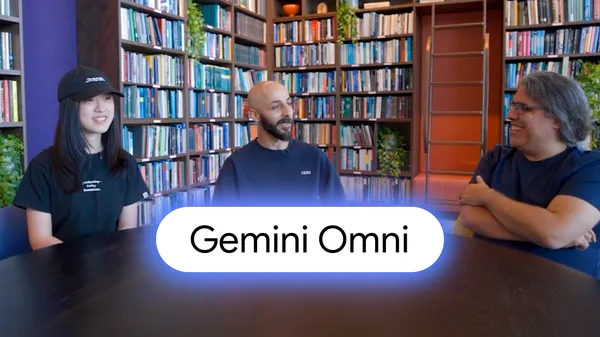
GoogleはGemini Omniの開発に携わった専門家へのインタビューを公開し、モデルの技術的な特徴や可能性について各自の視点から解説している。
Google published a roundtable with engineers and researchers behind Gemini Omni, offering insider perspectives on the model's capabilities and what makes it technically significant.
本ページの本文と要約は AI による自動生成です。日本語版と英語版は言語ごとに独立して生成されるため、表現や詳しさが異なる場合があります。正確性は元記事 (blog.google) をご確認ください。The body and summaries are AI-generated independently for each language, so wording and detail may differ. Verify accuracy at the original source (blog.google).
要約と収集メタデータに基づく AI 解説。元記事全文の転載・翻訳ではありません。AI explainer based on the summaries and collected metadata, not a copy or translation of the full source article.
Googleは、同社のAIモデル「Gemini Omni」の開発に携わったエンジニアや研究者へのインタビューを公開した。モデルの技術的な特徴や可能性について、開発現場の当事者が自らの視点で語る内容で、外部からは見えにくい設計思想や期待を伝える試みとなっている。
公開されたのは座談会形式の記事で、専門家たちがこのモデルの何に最も心を動かされているのかを率直に語っている。数値的な性能指標だけでなく、開発者個人の言葉を通じて技術的な意義を示そうとしている点が特徴だ。こうしたインタビューには、製品の背景にある研究の厚みや、チームが重視する価値観を伝える狙いがあると見られる。
「Gemini」はGoogleが展開するAIモデルのシリーズで、テキストや画像、音声など複数の種類の情報を扱えるマルチモーダル性を打ち出してきた。「Omni(オムニ)」という名称は「あらゆる」を意味する接頭辞であり、幅広い入力や用途に対応することを示唆する呼称と受け取れる。ただし今回の記事でどの機能が具体的に強調されているかは、公開された内容に沿って確認する必要がある。
背景には、生成AIをめぐる各社の激しい開発競争がある。OpenAIやAnthropicなどが相次いで高性能なモデルを投入するなか、Googleは研究成果と製品開発を結びつけながらGeminiシリーズを拡充してきた。モデルそのものの発表に加えて開発者の声を届けるコンテンツを用意することは、技術的な信頼性や開発体制への理解を深めてもらう狙いがあると考えられる。
「作り手が語る」形式の情報発信は、AI業界で広がりつつある。性能の数字だけでは伝わりにくい設計上の判断や、研究者が感じている手応え、今後の課題を言葉にすることで、利用者や開発者コミュニティとの対話を促す効果が期待される。Gemini Omniが実際にどのような場面で活用され、どの程度の評価を得るのかは、今後の展開を見守る必要がある。
Google has published a roundtable-style interview with several of the engineers and researchers who worked on Gemini Omni, giving an insider view of the model's capabilities and what its creators consider technically significant. For anyone tracking the direction of large AI systems, the piece is notable less for any single product announcement and more for what it reveals about the priorities and design philosophy guiding Google's latest work.
According to the source material, the conversation gathers experts behind Gemini Omni to discuss what excites them most about the model. This format has become a common way for AI labs to communicate research context that does not fit neatly into a technical report or a marketing page. Rather than reciting benchmark scores, the participants appear to focus on the reasoning that shaped the model, the problems they were trying to solve, and the areas they believe hold the most promise going forward.
The "Omni" naming is worth reading carefully. In current industry usage, the term generally signals a model built to handle multiple input and output modalities—text, images, audio, and potentially video—within a single unified system, rather than stitching together separate specialized components. Google has not, in this piece, redefined the broader Gemini strategy, so Gemini Omni is best understood as part of the existing Gemini family rather than a departure from it. The interview appears intended to complement, not replace, the more formal documentation that typically accompanies a model release.
Placing this in context, Gemini is Google's flagship line of general-purpose models, spanning tiers designed for on-device efficiency through to large-scale cloud deployment. The company has steadily integrated these models across its ecosystem, including search features, Workspace productivity tools, and developer access through its API and cloud platform. A roundtable like this one fits a longer pattern in which Google DeepMind and Google's product teams periodically surface the people behind the work, both to explain design tradeoffs and to build credibility with the developer and research communities that ultimately adopt these systems.
The broader industry backdrop helps explain why such a discussion matters. Multimodal capability has become a central competitive axis among the major AI labs. OpenAI popularized the "omni" framing with its own real-time, multimodal models, while Anthropic, Meta, and others have pushed comparable directions with their respective model families. In that environment, the way a team articulates its priorities—latency, grounding, safety, reasoning, or breadth of modality—can be as informative as the raw specifications, because it hints at where the next round of improvements is likely to land.
Interviews of this kind also serve an educational function for readers who are not specialists. They tend to touch on prerequisite concepts such as how models are trained on diverse data, how different modalities are represented internally, and why unifying them can reduce the brittleness that comes from chaining separate systems. Without overstating what the published conversation contains, it is reasonable to expect the participants to frame these ideas in accessible terms, given that the stated goal is to share what they find most exciting rather than to deliver an exhaustive technical breakdown.
Readers should approach the enthusiasm expressed in any first-party interview with appropriate caution. Comments from the people who built a system are valuable for understanding intent and ambition, but they are not a substitute for independent evaluation. Claims about capability, reliability, and real-world performance are typically best confirmed through third-party testing, external benchmarks, and hands-on use once a model is broadly available. The roundtable is likely most useful as a window into design thinking and roadmap direction rather than as a definitive account of what the model can do.
For developers, enterprises, and observers weighing where to invest attention, the practical takeaway is that Google continues to treat Gemini as a strategic, evolving platform and is willing to explain its reasoning publicly. Following the specifics the experts choose to emphasize—and, just as importantly, what they leave unsaid—can offer early signals about how Gemini Omni may be positioned against competing systems and how it might be incorporated into the tools and services that many users already rely on.
ポコとTECHガイドPoko & TECH Guide
ポコと当サイトのTECHガイドが、記事の要約と収集した情報から読みどころを語るAI生成の対話です。Poko and TECH Dashboard's own TECH Guide discuss the article's highlights in an AI-generated conversation based on its summary and collected source details.
- ポコPokoGemini Omniって、今回は何が発表されたの?新モデルそのものの発表?What exactly was announced about Gemini Omni here? Is this a new model launch?
- TECHガイドTECH Guide記事によれば、Googleが開発に携わった専門家へのインタビューを公開したのじゃ。モデルの特徴や可能性を内側の視点で語る内容じゃよ。According to the article, Google published interviews with experts who worked on Gemini Omni. They discuss its capabilities and potential from an insider perspective.
- ポコPoko開発した人たちの話を聞けると、何が嬉しいの?What’s useful about hearing directly from the people who built it?
- TECHガイドTECH Guide簡単に言うとじゃな、どこに技術的な価値を感じているかを本人たちの視点で知れることじゃ。期待する点も紹介されておる。Simply put, we get to see what the builders themselves find technically meaningful. The interviews also highlight what excites them about the model.
- ポコPokoなるほど!性能を並べるだけじゃなく、専門家が注目する特徴や可能性を知れるんだね。Got it! So it’s not just a list of capabilities—we also learn which features and possibilities the experts find compelling.
- TECHガイドTECH Guideその通りじゃ。記事で専門家ごとの視点を追いながら、どんな技術的特徴や可能性が語られるかに注目じゃな。Exactly. The key is to follow each expert’s perspective and note which technical qualities and possibilities they emphasize.