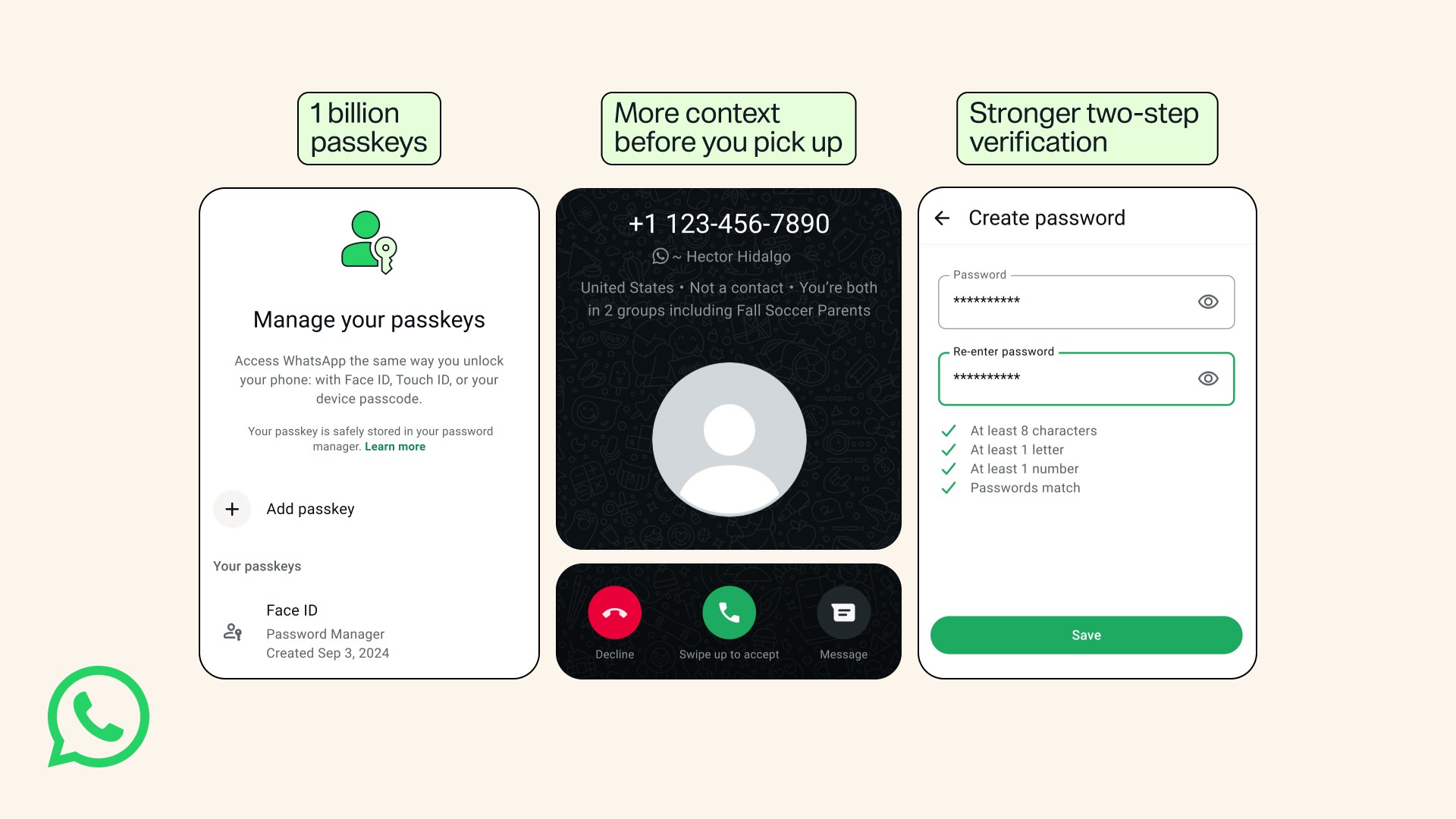
WhatsAppに新しいアカウントセキュリティ機能が追加New Account Security Features for WhatsApp
匿名の公開いいねです。記事の保存・お気に入りではなく、Featured、Top 3、重要度、掲載順位には影響しません。仕組みとプライバシーAnonymous public likes are reactions, not saved articles or bookmarks. They do not affect Featured, Top 3, importance, or listing order.How it works and privacy
- MetaはWhatsAppに強化された二段階認証と、知らない番号からの着信に追加情報を表示する機能を導入した。
- これによりユーザーのアカウント保護と詐欺対策が向上する。
Meta is rolling out enhanced two-step verification and contextual information for calls from unknown numbers on WhatsApp, strengthening user account protection against unauthorized access and potential scams.
本ページの本文と要約は AI による自動生成です。日本語版と英語版は言語ごとに独立して生成されるため、表現や詳しさが異なる場合があります。正確性は元記事 (about.fb.com) をご確認ください。The body and summaries are AI-generated independently for each language, so wording and detail may differ. Verify accuracy at the original source (about.fb.com).
要約と収集メタデータに基づく AI 解説。元記事全文の転載・翻訳ではありません。AI explainer based on the summaries and collected metadata, not a copy or translation of the full source article.
Metaは、メッセージングアプリ「WhatsApp」に新しいアカウントセキュリティ機能を追加すると発表した。強化された二段階認証と、知らない番号からの着信に追加情報を表示する仕組みを導入し、不正アクセスや詐欺への対策を高める狙いがあるとしている。
二段階認証(two-step verification)は、パスワードや確認コードに加えてもう一段階の本人確認を挟むことで、第三者による乗っ取りを防ぐ仕組みだ。WhatsAppでは以前から、新しい端末でアカウントを登録し直す際にユーザーが設定した暗証番号(PIN)を求める形で提供されてきた。今回はこの二段階認証をより強固にすることで、SIMスワップやコード詐取といった手口によるアカウント侵害のリスクを下げると見られる。
もう一つの柱が、登録していない番号からの着信に対して追加のコンテキストを表示する機能だ。近年、通話やメッセージを起点にした詐欺(いわゆるスミッシングやなりすまし)が世界的に増えており、相手が連絡先に登録されていない場合、ユーザーが正当な相手かどうかを判断しにくいという課題があった。着信時により多くの手がかりを提示することで、不審な相手からの接触を利用者自身が見極めやすくすることを意図しているとみられる。
こうした取り組みは、Metaがプライバシーとセキュリティを訴求する近年の方針とも重なる。WhatsAppはメッセージにエンドツーエンド暗号化を採用しており、通信内容の保護を打ち出してきた。一方で、暗号化された通信であってもアカウントそのものが乗っ取られれば被害につながるため、認証や着信管理といった「入り口」の防御を固める必要性が指摘されてきた。
同種の機能強化は業界全体の潮流でもある。GoogleやAppleもパスキーやデバイス認証の導入を進めており、パスワードのみに依存しない多層的な防御が主流になりつつある。数十億人規模の利用者を抱えるWhatsAppにとって、詐欺対策とアカウント保護は継続的な課題であり、今回の追加はその一環と位置づけられる。
なお、機能の具体的な展開時期や対象となる地域、対応環境の詳細については、Metaの公式発表や今後のアップデート情報を確認する必要がある。利用者側でも、二段階認証の有効化や不審な着信への注意といった基本的な対策を併用することが、被害を避けるうえで重要となりそうだ。
Meta has announced a set of new account security features for WhatsApp, including stronger two-step verification and additional context for calls placed by unknown callers. The changes matter because WhatsApp is one of the world's most widely used messaging platforms, with a user base spanning billions of people, and its accounts are a frequent target for account-takeover attempts and scam campaigns. Strengthening the defenses around sign-in and unfamiliar contact attempts addresses two of the most common ways that ordinary users are exposed to fraud.
At the center of the update is an enhancement to two-step verification, the optional feature that adds a layer of protection beyond a standard SMS registration code. Two-step verification on WhatsApp traditionally works by letting users set a personal identification number, or PIN, that must be entered when the account is registered on a new device. This helps guard against attackers who manage to intercept or socially engineer a one-time code, a technique often used in so-called SIM-swap attacks. By making this verification stronger, Meta appears to be raising the barrier for anyone attempting to move an account to a device they do not own, though the company frames the improvement as part of a broader effort rather than a single mechanism.
The second feature focuses on calls from unknown numbers. According to Meta, WhatsApp will now surface additional context when a call arrives from someone not saved in a user's contacts. Displaying more information about an unfamiliar caller is intended to help people make a more informed decision about whether to answer, mute, or block the call. This is relevant because voice and video calls have increasingly been used as an entry point for scams, where fraudsters attempt to build trust or create urgency before requesting money or sensitive information. Giving recipients context up front is a relatively lightweight but potentially meaningful way to reduce the effectiveness of such approaches.
These additions fit within a wider pattern across Meta's messaging services, which have gradually layered on protective controls over the past several years. WhatsApp already offers tools such as the ability to silence calls from unknown numbers, block and report contacts, and passkey support that lets users log in with biometric or device-based credentials instead of a password. The platform's messages and calls are protected by end-to-end encryption by default, meaning the content is not readable by WhatsApp itself. Account-level protections like two-step verification are complementary to that encryption, since they guard the account and device registration process rather than the confidentiality of the conversations.
The move also reflects broader industry trends around authentication and fraud prevention. Across the technology sector, providers have been steadily shifting users away from reliance on SMS-only codes, which are vulnerable to interception, and toward stronger factors such as app-based verification, hardware security keys, and passkeys built on the FIDO standards. Regulators and consumer-protection bodies in several regions have also increased pressure on platforms to do more to curb messaging-based fraud, which has grown alongside the popularity of chat apps for both personal and commercial communication. Seen in that light, WhatsApp's changes are consistent with the direction competitors and peers have taken.
For everyday users, the practical takeaway is that enabling two-step verification remains one of the simplest and most effective steps to protect an account, and the strengthened version is likely to make that protection more robust. The added caller context, meanwhile, is designed to help users exercise caution without needing to block communication outright. As with many staged feature releases, availability may roll out gradually across regions, platforms, and app versions, so not every user is likely to see the new options at the same time.
Meta published details of the changes through its Meta Newsroom blog. The company has not framed the update as a wholesale redesign of WhatsApp security, but rather as an incremental reinforcement of existing safeguards. Users who want to take advantage of the features can typically review their security options within the app's settings, and are generally encouraged to keep the application updated to receive the latest protections as they become available in their market.
ポコとTECHガイドPoko & TECH Guide
ポコと当サイトのTECHガイドが、記事の要約と収集した情報から読みどころを語るAI生成の対話です。Poko and TECH Dashboard's own TECH Guide discuss the article's highlights in an AI-generated conversation based on its summary and collected source details.
- ポコPokoWhatsAppの「強化された二段階認証」って何?普通の認証とどう違うの?What does “enhanced two-step verification” on WhatsApp mean? How is it different from regular verification?
- TECHガイドTECH Guide簡単に言うと、本人確認を二段階にして不正アクセスを防ぎやすくする仕組みじゃな。記事では、その保護が強化されるとしておるよ。Simply put, two-step verification checks your identity in two stages to help prevent unauthorized access. The article says WhatsApp is strengthening that protection.
- ポコPokoへえ、すごい!知らない番号からの着信に追加情報が出ると、何が嬉しいの?Oh, nice! What’s helpful about showing extra information for calls from unknown numbers?
- TECHガイドTECH Guide記事によれば、着信の背景を判断する手がかりが増え、詐欺の可能性に気づきやすくなるのが利点じゃよ。According to the article, the added context gives users more clues about an incoming call, making potential scams easier to spot.
- ポコPokoつまり、ログイン時の守りを強くして、怪しい着信も見分けやすくするんだね。So it strengthens account protection and makes suspicious calls easier to recognize.
- TECHガイドTECH Guideその理解でよいぞ。今後は、追加情報が実際の着信でどう示され、判断に役立つかが見どころじゃな。Exactly. The key thing to watch is how that extra context appears on real calls and whether it helps users make safer decisions.





