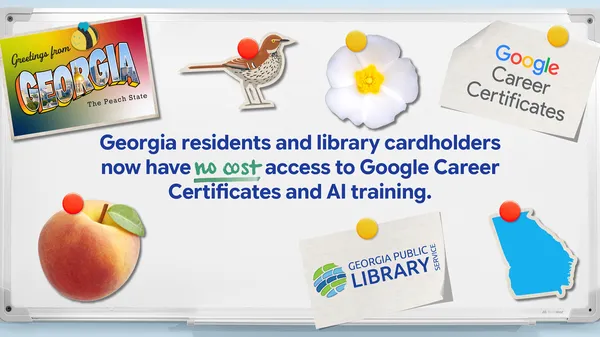
GoogleがGeorgiaの公共図書館サービスと提携し、無償でキャリアおよびAIトレーニングを提供We’re partnering with the Georgia Public Library Service for no-cost career and AI training.
匿名の公開いいねです。記事の保存・お気に入りではなく、Featured、Top 3、重要度、掲載順位には影響しません。仕組みとプライバシーAnonymous public likes are reactions, not saved articles or bookmarks. They do not affect Featured, Top 3, importance, or listing order.How it works and privacy
- GoogleはGeorgia公共図書館サービスと連携し、州内の住民が図書館を通じて無料でキャリア支援やAIスキルトレーニングを受けられる機会を提供する。
- デジタルスキル格差の解消を目指す取り組みとして注目される。
Google is partnering with the Georgia Public Library Service to offer free career development and AI skills training through local libraries, expanding access to digital education for residents across the state.
本ページの本文と要約は AI による自動生成です。日本語版と英語版は言語ごとに独立して生成されるため、表現や詳しさが異なる場合があります。正確性は元記事 (blog.google) をご確認ください。The body and summaries are AI-generated independently for each language, so wording and detail may differ. Verify accuracy at the original source (blog.google).
要約と収集メタデータに基づく AI 解説。元記事全文の転載・翻訳ではありません。AI explainer based on the summaries and collected metadata, not a copy or translation of the full source article.
Googleは、米ジョージア州の公共図書館ネットワークを運営するGeorgia Public Library Serviceと提携し、州内の住民が地域の図書館を通じて無料でキャリア支援やAIスキルの研修を受けられる取り組みを始めると発表した。デジタル教育へのアクセスを地域社会に広げ、スキル格差の解消を狙う動きとして注目される。
この提携は、Googleが世界的に展開する人材育成プログラム「Grow with Google」の一環と見られる。同プログラムはこれまでも履歴書の作成支援やオンライン就職活動のノウハウ、データ分析やITサポートといった専門職向けの認定講座などを提供してきた。今回はそこに、生成AIの基礎知識や実務での活用方法を学べる研修が加わる形とされる。図書館という誰もが無料で利用できる公共空間を窓口にすることで、これまでオンライン学習から取り残されがちだった層にも門戸を開く意図があるとみられる。
背景には、AIの急速な普及に伴う「デジタルスキル格差」への懸念がある。生成AIは業務効率化や新たな職種を生む一方、使いこなせる人とそうでない人の間で機会の差が広がる可能性が指摘されてきた。特に地方部や低所得層では、学習環境やデバイス、インターネット環境の制約が壁になりやすい。公共図書館はこうした地域で情報アクセスの拠点として機能してきた歴史があり、キャリア教育の受け皿としての役割が改めて見直されている。
図書館と大手テック企業の連携は、Googleに限った動きではない。MicrosoftやAmazonなども、自社のクラウド技術やAIツールに関する無料の学習コンテンツを公開し、就労支援や職業訓練機関との協力を進めてきた。企業側にとっては、将来的な人材育成や自社サービスの利用者層拡大につながる側面もあり、社会貢献と事業戦略が重なり合う領域といえる。
一方で、こうした研修が具体的にどのような教材や講師体制で提供されるのか、受講者のキャリアにどこまで結びつくのかは、今後の運用状況を見て評価される必要がある。特定企業のツールに偏った学習内容にならないかという視点も含め、公共サービスと民間企業の連携がどのような成果を生むのか、他州や他国の同種の取り組みとあわせて注視される。
Google has announced a partnership with the Georgia Public Library Service to deliver free career development and artificial intelligence skills training to residents across the state, using local libraries as the primary point of access. The collaboration is notable because it channels digital education through an existing public institution that already reaches communities of varying income levels, geographies, and technology access, positioning libraries as intermediaries for skills that are increasingly tied to employment prospects.
The initiative appears to operate under Google's Grow with Google banner, the company's long-running program aimed at expanding digital literacy and workforce readiness. Grow with Google has historically offered a mix of self-paced online courses, in-person workshops, and structured credentials, and partnerships with libraries have been a recurring delivery method. By working with the Georgia Public Library Service, which coordinates a statewide network of local library systems, the program can distribute training materials, host events, and provide guidance to patrons who might not otherwise seek out online learning platforms on their own.
A central element of the announcement is the inclusion of AI skills training. Google has developed introductory offerings such as Google AI Essentials, a course designed to teach non-specialists how generative AI tools work, how to write effective prompts, and how to apply these tools responsibly in everyday tasks. While the specific curriculum available through Georgia libraries has not been detailed exhaustively, it is likely to draw on these existing resources rather than introduce entirely new material. The emphasis reflects a broader industry shift in which familiarity with AI tools is being treated as a foundational workplace competency rather than a specialized technical skill.
Alongside AI content, the partnership includes broader career development resources. Grow with Google is associated with the Google Career Certificates, credentials in fields such as data analytics, IT support, project management, cybersecurity, and digital marketing. These certificates are hosted on Coursera and are intended to prepare learners for entry-level roles without requiring a traditional college degree. Libraries participating in the program may offer access to these courses, help with résumé building, or provide interview preparation, though the exact scope of services in Georgia will depend on local implementation.
The stated goal of narrowing the digital skills gap situates the effort within a well-documented policy concern. Many workers lack access to the training, hardware, or reliable internet connections needed to build in-demand digital competencies, and rural and lower-income communities are often disproportionately affected. Public libraries have long served as free access points for computers and internet, which makes them a logical partner for programs seeking to reach underserved populations. The arrangement also allows Google to extend its reach without building new physical infrastructure, while the library system gains structured content to support its existing educational mission.
The move fits a pattern of technology companies investing in workforce training as demand for AI-related skills grows. Microsoft, through its LinkedIn Learning platform and various skilling initiatives, and Amazon, through programs such as AWS training, have pursued similar strategies. Such efforts serve multiple purposes: they address genuine labor market needs, build familiarity with a company's ecosystem of tools, and generate goodwill with governments and the public. Observers have noted that these programs can encourage adoption of a provider's products even as they deliver broadly useful skills, and the Georgia partnership can be read in that context.
For residents, the practical benefit is access to no-cost training that might otherwise carry fees or require self-directed navigation of online catalogs. The involvement of librarians, who can offer in-person guidance, may lower barriers for people less comfortable with digital platforms. It remains to be seen how many Georgians will take up the offerings and how outcomes such as job placement or wage gains will be measured, and neither party has published detailed targets at this stage.
The announcement adds to a growing number of state and local collaborations tied to AI education as governments and institutions weigh how to prepare workforces for tools that are being integrated across many industries. Whether library-based training proves an effective channel for reaching those most affected by the skills gap will likely become clearer as the program matures and any usage data is released.