Blueprint:VoicifyがAI注文体験を顧客にとって快適にする方法The Blueprint: How Voicify makes AI-enabled ordering a delight for customers
匿名の公開いいねです。記事の保存・お気に入りではなく、Featured、Top 3、重要度、掲載順位には影響しません。仕組みとプライバシーAnonymous public likes are reactions, not saved articles or bookmarks. They do not affect Featured, Top 3, importance, or listing order.How it works and privacy
- VoicifyはGoogle CloudのGeminiを活用し、飲食店向けの音声AIordering体験を構築。
- 電話注文を自然な会話で処理し、顧客満足度と業務効率を同時に向上させている。
Voicify leverages Google Cloud's Gemini to power conversational AI phone ordering for restaurants, enabling natural voice interactions that improve both customer satisfaction and operational efficiency.
本ページの本文と要約は AI による自動生成です。日本語版と英語版は言語ごとに独立して生成されるため、表現や詳しさが異なる場合があります。正確性は元記事 (cloud.google.com) をご確認ください。The body and summaries are AI-generated independently for each language, so wording and detail may differ. Verify accuracy at the original source (cloud.google.com).
要約と収集メタデータに基づく AI 解説。元記事全文の転載・翻訳ではありません。AI explainer based on the summaries and collected metadata, not a copy or translation of the full source article.
飲食店の電話注文は、店舗運営における長年の課題だ。ピーク時には従業員が調理や接客に追われ、鳴り続ける電話に出られないまま機会損失が生じる。米国発のVoicifyは、この電話注文をGoogle CloudのGeminiで自動化し、自然な会話で受け付ける音声AIを構築している。同社の取り組みはGoogle Cloudのブログ「Blueprint」シリーズで紹介された。
Voicifyのシステムは、かかってきた電話に対し、メニューの案内から注文内容の確認、カスタマイズの受け付けまでを人間に近い対話で処理するとされる。従来の自動音声応答(IVR)がボタン操作や定型的な発話に依存していたのに対し、大規模言語モデルを活用することで、言い直しや曖昧な表現、雑談交じりの注文にも柔軟に応じられる点が特徴と見られる。
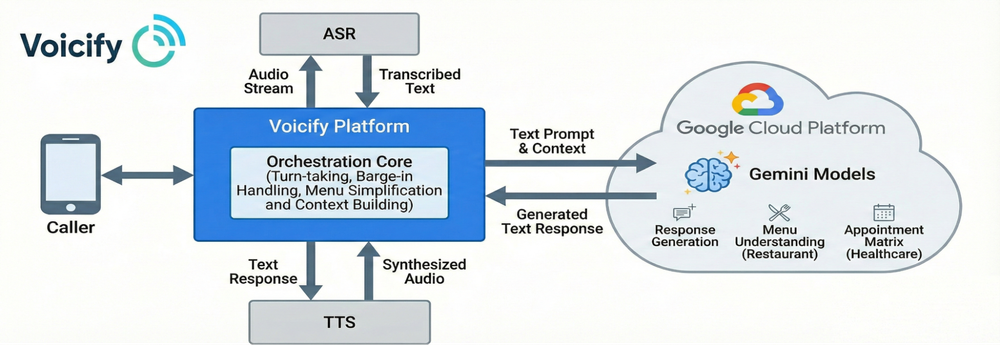
技術的な背景として、こうした音声注文の体験は複数の要素技術の組み合わせで成り立つ。顧客の発話をテキスト化する音声認識、意図や注文品目を解釈する自然言語理解、そして応答を生成し音声に変換する工程が連携する。GeminiはGoogleが提供する生成AIモデル群で、文脈を保った対話や複雑な指示の解釈に強みを持つとされ、注文のような多段階のやり取りに適した基盤になり得る。Google CloudはこれらをAPIやプラットフォームとして提供しており、Voicifyのような専業ベンダーが自社サービスに組み込みやすい環境が整いつつある。
飲食業界では慢性的な人手不足を背景に、AIによる注文自動化への関心が高まっている。ドライブスルーや電話注文の音声AIは、複数のテック企業や大手チェーンが実証実験を進めてきた分野でもあり、競争や技術の成熟が進む可能性がある。一方で、騒音下での認識精度や、注文ミスが生じた際の対応、顧客が人間の対応を望むケースへの配慮など、実運用では乗り越えるべき点も残る。
Voicifyが強調するのは、顧客満足度と業務効率の両立だ。取りこぼしていた電話注文を確実に受けられれば売上機会の回復につながり、従業員は付加価値の高い業務に集中しやすくなる。今回の事例は、生成AIが顧客接点の自動化にどう寄与し得るかを示す一例と言え、同様の仕組みが今後ほかの業種にも広がる可能性がある。
Restaurants lose measurable revenue every time a phone rings during a rush and no one can answer it, and Voicify is positioning its conversational ordering platform as a direct response to that problem. In a recent Google Cloud "Blueprint" case study, the company describes how it uses Gemini to power AI-driven phone ordering for restaurants, aiming to handle calls in natural spoken language rather than forcing customers through rigid menus or leaving them on hold. The pitch is straightforward: capture orders that would otherwise be missed while freeing staff to focus on in-store guests.
The core of the system is a voice agent that answers inbound calls, understands what a customer wants, and completes an order without human intervention in most cases. According to the described setup, Gemini serves as the reasoning layer that interprets requests, manages the back-and-forth of a conversation, and handles the ambiguity that is common in real speech. Customers rarely order in clean, structured phrases; they change their minds, ask about ingredients, request substitutions, and speak over background noise. A large language model is well suited to parsing that kind of messy, context-dependent input and mapping it to concrete menu items and modifiers.
Technically, a deployment like this typically combines several components. Speech-to-text converts the caller's audio into text, the language model interprets intent and generates a response, and text-to-speech produces a natural-sounding reply. For a phone ordering use case, latency matters a great deal, because long pauses feel unnatural and frustrate callers, so systems of this type are usually engineered to respond within a conversational rhythm. Gemini's function calling, often referred to as tool use, appears central to making the experience reliable: the model can be connected to a restaurant's live menu, pricing, and availability data so that it grounds its answers in real information rather than guessing. That grounding is important for accuracy, since an AI that invents an item or a price would create operational headaches at the point of sale.
Integration with existing restaurant infrastructure is another key piece. To be useful, the voice agent has to push completed orders into a point-of-sale or online ordering system and reflect real-time details such as which items are sold out or how customization options are priced. The described approach also allows for upselling and suggested add-ons, which restaurants value because they can lift average ticket size. Voicify frames the combined result as improving both customer satisfaction, through faster and more consistent service, and operational efficiency, by reducing the number of abandoned or unanswered calls.
The broader context is a wave of experimentation with voice AI across the food service industry. Several chains have tested automated drive-thru ordering, with mixed public results; some high-profile pilots were scaled back after accuracy proved difficult in noisy, high-volume environments. Google Cloud itself has previously worked with restaurant brands on conversational ordering, and competitors such as SoundHound and others have pursued similar voice-commerce niches. The renewed interest is largely driven by the maturation of multimodal foundation models, which handle spoken language far more fluidly than the intent-and-slot chatbots of a few years ago, combined with persistent labor shortages that make automation of routine phone work attractive to operators.
For readers less familiar with the underlying concepts, the relevant building blocks are worth noting. Grounding refers to tying a model's outputs to a trusted data source to reduce fabrication. Function calling lets a model trigger external actions, such as querying a menu database or submitting an order, rather than only producing text. And retrieval or structured data connections keep the agent aligned with information that changes frequently, like daily specials or stock levels. These are the same patterns showing up across enterprise Gemini deployments in other sectors.
As with any automated customer-facing system, the practical questions center on reliability, handling of edge cases, and graceful handoff to a human when the AI reaches its limits. The Google Cloud write-up presents Voicify's implementation as a working example rather than an independent benchmark, so the reported gains in satisfaction and efficiency should be read as the vendor's own framing. Still, the case illustrates how conversational AI is moving from demonstrations into revenue-affecting, day-to-day restaurant operations.
ポコとTECHガイドPoko & TECH Guide
ポコと当サイトのTECHガイドが、記事の要約と収集した情報から読みどころを語るAI生成の対話です。Poko and TECH Dashboard's own TECH Guide discuss the article's highlights in an AI-generated conversation based on its summary and collected source details.
- ポコPokoGeminiで電話注文を自然な会話として処理するって、どういうこと?音声AIが注文を聞くの?What does it mean to use Gemini for natural phone ordering? Does a voice AI listen to the customer’s order?
- TECHガイドTECH Guide記事によれば、VoicifyがGoogle CloudのGeminiを活用し、飲食店向けの会話型AI電話注文を構築したんじゃ。声で自然にやり取りできる仕組みじゃよ。According to the article, Voicify uses Google Cloud’s Gemini for conversational AI phone ordering at restaurants. Simply put, it lets customers place orders through natural voice interactions.
- ポコPokoへえ、すごい!それって、お客さんや飲食店には何がうれしいの?Wow, that’s neat! What’s the benefit for customers and restaurants?
- TECHガイドTECH Guide記事では、自然な電話注文によって顧客満足度と業務効率を同時に向上させているとあるぞ。会話の快適さと仕事の進めやすさを両立する狙いじゃな。The article says natural phone ordering improves both customer satisfaction and operational efficiency. In plain terms, it aims to make ordering pleasant while helping restaurant work run more efficiently.
- ポコPokoつまり、VoicifyはGeminiを使って、電話注文を自然で快適にしつつ、飲食店の業務も効率化しているんだね!So Voicify uses Gemini to make phone orders feel natural and pleasant while also improving restaurant efficiency!
- TECHガイドTECH Guideその通りじゃ。注目点は満足度と効率の両立じゃが、この情報では具体的な効果の数値までは分からない点に注意じゃよ。Exactly. The key point is improving satisfaction and efficiency together, though the information provided doesn’t include specific measurements of those gains.