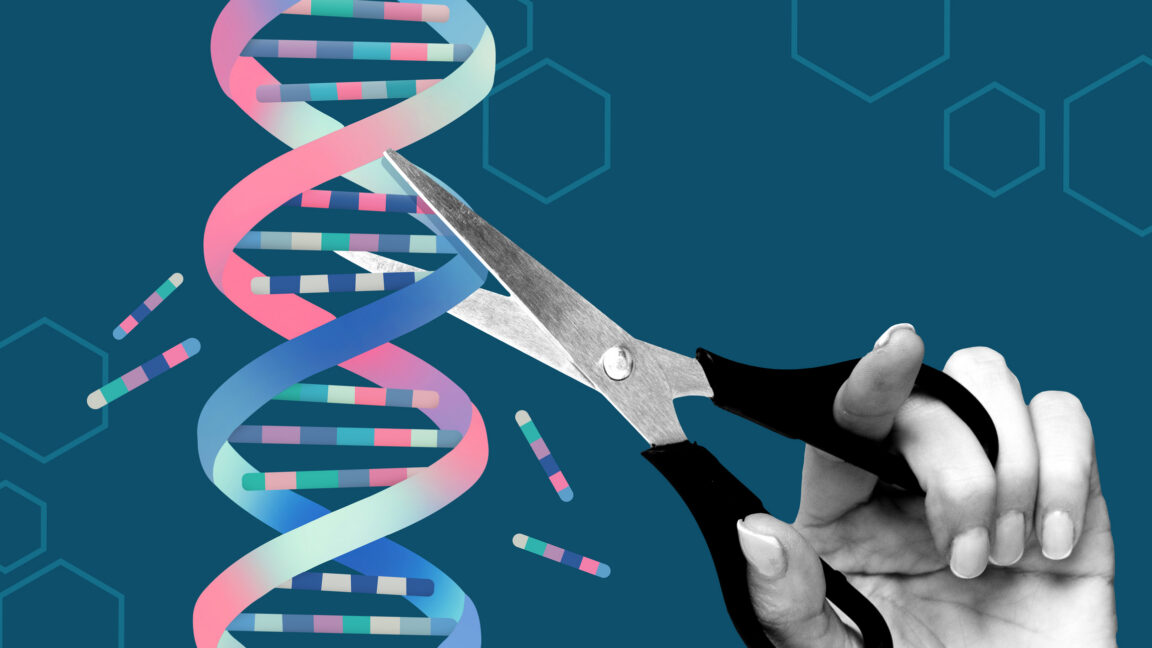
AlphaFold AIを活用して遺伝子編集タンパク質を再設計、安全性を向上Team uses AlphaFold AI to redesign gene-editing proteins to make them safer
匿名の公開いいねです。記事の保存・お気に入りではなく、Featured、Top 3、重要度、掲載順位には影響しません。仕組みとプライバシーAnonymous public likes are reactions, not saved articles or bookmarks. They do not affect Featured, Top 3, importance, or listing order.How it works and privacy
研究チームがAlphaFoldを用いてCRISPR関連タンパク質の構造を再設計し、オフターゲット効果を低減することで遺伝子治療の安全性向上に貢献した。
Researchers used AlphaFold to reengineer gene-editing proteins, reducing off-target effects and improving safety for potential therapeutic applications.
本ページの本文と要約は AI による自動生成です。日本語版と英語版は言語ごとに独立して生成されるため、表現や詳しさが異なる場合があります。正確性は元記事 (arstechnica.com) をご確認ください。The body and summaries are AI-generated independently for each language, so wording and detail may differ. Verify accuracy at the original source (arstechnica.com).
要約と収集メタデータに基づく AI 解説。元記事全文の転載・翻訳ではありません。AI explainer based on the summaries and collected metadata, not a copy or translation of the full source article.
研究チームが、DeepMindの構造予測AI「AlphaFold」を活用してCRISPR関連タンパク質を再設計し、遺伝子編集の安全性を高めたと報告した。狙った以外の配列を切断してしまう「オフターゲット効果」を抑えることで、遺伝子治療への応用に一歩近づく成果と位置づけられる。
CRISPR-Cas9に代表されるゲノム編集技術は、ガイドRNAが指定するDNA配列をCasタンパク質が切断する仕組みで動く。しかし実際には、狙った配列とよく似た別の場所を誤って切ってしまうことがあり、これが意図しない変異や副作用のリスクとなってきた。治療目的で人体に用いる際には、この精度の低さが大きな課題とされてきた。
今回のアプローチでは、AlphaFoldが予測するタンパク質の立体構造を手がかりに、DNAとの結合部位などを改変し、より特異性の高い酵素を設計したとみられる。AlphaFoldはアミノ酸配列から立体構造を高精度で推定できるため、実験で構造を解析する前に候補分子の性質を絞り込み、開発サイクルを短縮できる可能性がある。
タンパク質設計へのAI活用は近年急速に広がっている。2024年にはAlphaFoldの開発者らがノーベル化学賞を受賞し、米ワシントン大学のBakerらが手がけた「RFdiffusion」や「ProteinMPNN」など、狙った機能を持つタンパク質を一から作り出す手法も登場している。今回の研究も、こうした潮流の延長線上にあると言える。
ただし、計算上の予測がそのまま臨床応用につながるわけではない。設計した酵素が生体内で期待通りに機能するか、免疫反応を引き起こさないかなど、実験や動物モデルでの検証が引き続き必要になる。それでも、AIによる構造予測と分子設計の組み合わせが、遺伝子治療の安全性を底上げする有力な手段となる可能性は高いと見られる。今後は他のCasタンパク質や塩基編集ツールへの応用が進むかどうかが注目される。
Researchers have reportedly used DeepMind's AlphaFold protein-structure prediction system to redesign the proteins at the heart of CRISPR gene editing, aiming to reduce so-called off-target effects that have long complicated efforts to bring genome editing safely into the clinic. The work matters because unintended edits at the wrong sites in the genome remain one of the central safety concerns for gene therapies, and computational protein design offers a route to engineering more precise tools without the slow, expensive trial and error of purely laboratory-based approaches.
CRISPR systems typically pair a guide RNA, which matches a target DNA sequence, with a nuclease protein such as Cas9 that cuts the DNA at that location. The precision of an edit depends heavily on how tightly the protein and guide discriminate between the intended sequence and similar-looking sequences elsewhere in the genome. When the machinery tolerates mismatches, it can cut at unintended locations, potentially disrupting healthy genes or introducing harmful mutations. Reengineering the nuclease so that it binds and cleaves only when the match is exact is therefore a direct way to improve safety.
According to the reported work, the team used AlphaFold to model how candidate protein variants would fold and interact with DNA, then used those predictions to guide which amino acid changes to introduce. Because AlphaFold can generate structural predictions far faster than experimental methods such as X-ray crystallography or cryo-electron microscopy, it allows researchers to screen many hypothetical designs computationally before committing to bench experiments. The approach appears to combine structural prediction with iterative testing, using the model to narrow a vast space of possible sequences down to a smaller set of promising candidates that are then validated in the lab.
It is worth noting the distinction between structure prediction and de novo protein design. AlphaFold, first released by DeepMind in 2020 and dramatically expanded with AlphaFold2 and later AlphaFold3, was built primarily to predict the three-dimensional shape of a protein from its amino acid sequence. Designing entirely new or heavily modified proteins is a related but separate challenge, and tools such as the University of Washington's RoseTTAFold and RFdiffusion, developed in David Baker's lab, are aimed more explicitly at generating novel structures. In practice, researchers increasingly combine predictive and generative models, and using AlphaFold to evaluate or refine engineered variants of an existing protein like Cas9 fits that emerging pattern.
The broader context is a wave of interest in what is sometimes called AI-driven biology. The 2024 Nobel Prize in Chemistry was awarded in part for AlphaFold and for computational protein design, signaling how central these methods have become to the field. Gene editing itself reached a regulatory milestone in late 2023, when Casgevy, a CRISPR-based therapy for sickle cell disease and beta thalassemia, was approved in the United States and the United Kingdom. That approval demonstrated the clinical promise of the technology while also underscoring why safety refinements remain valuable, particularly as developers pursue in vivo editing, where the tool is delivered directly into the body rather than applied to cells outside it.
Reducing off-target activity is an active area beyond this specific study. Earlier engineered variants such as high-fidelity Cas9 and enhanced-specificity Cas9 were produced through more conventional protein engineering, and base editors and prime editors were developed to make more controlled changes with fewer double-strand breaks. Computational design tools could complement these efforts by making it faster to explore modifications and to understand why certain changes improve specificity.
Several caveats apply. Structural predictions, however accurate, do not fully capture the dynamic behavior of proteins as they search and bind DNA, so laboratory and eventually animal testing remain essential to confirm that a redesigned enzyme is both safer and still effective. Improvements measured in cell-based assays do not automatically translate into clinical benefit, and any therapeutic use would require extensive further validation and regulatory review. The reported reduction in off-target effects is likely an encouraging proof of concept rather than a finished therapeutic product.
Even so, the work illustrates a growing convergence between machine learning and molecular biology, in which predictive models increasingly inform the design of the biological tools themselves. If the approach holds up under wider scrutiny, it could accelerate the development of more precise gene-editing systems and offer a template for applying structure-prediction AI to other protein-engineering problems.
ポコとTECHガイドPoko & TECH Guide
ポコと当サイトのTECHガイドが、記事の要約と収集した情報から読みどころを語るAI生成の対話です。Poko and TECH Dashboard's own TECH Guide discuss the article's highlights in an AI-generated conversation based on its summary and collected source details.
- ポコPokoAlphaFoldでCRISPR関連タンパク質を再設計したって、どういうこと? オフターゲット効果も何?They redesigned CRISPR-related proteins with AlphaFold? What does that mean, and what are off-target effects?
- TECHガイドTECH Guide簡単に言うとじゃな、オフターゲット効果は意図しない場所まで編集することじゃ。記事によれば、AlphaFoldでミスにつながる部分を調べ、構造を再設計したんじゃよ。Simply put, off-target effects are edits made in unintended places. According to the article, AlphaFold helped identify protein regions linked to mistakes, allowing researchers to redesign the structure.
- ポコPokoそれを減らせると、何が嬉しいの? 遺伝子治療にすぐ使えるってこと?What’s the benefit of reducing those mistakes? Does that mean it can be used for gene therapy right away?
- TECHガイドTECH Guide記事では、オフターゲット効果の低減が遺伝子治療の安全性向上に貢献したとしておる。ただし、治療への応用は「可能性」として述べられているんじゃ。The article says reducing off-target effects contributed to safer gene therapy. But it describes therapeutic use as a potential application, not something already established.
- ポコPokoなるほど、AlphaFoldでミスに関わる部分を見つけて、より安全を目指す形に作り直したんだね。Got it. AlphaFold helped find the parts associated with errors, so the proteins could be redesigned with better safety in mind.
- TECHガイドTECH Guideその理解でよいぞ。今後の見どころは治療応用の可能性じゃが、記事の範囲では安全性向上への貢献まで、と捉えるのが大切じゃよ。Exactly. The potential for therapeutic use is worth watching, but based on this article, the key takeaway is the contribution to improved safety.