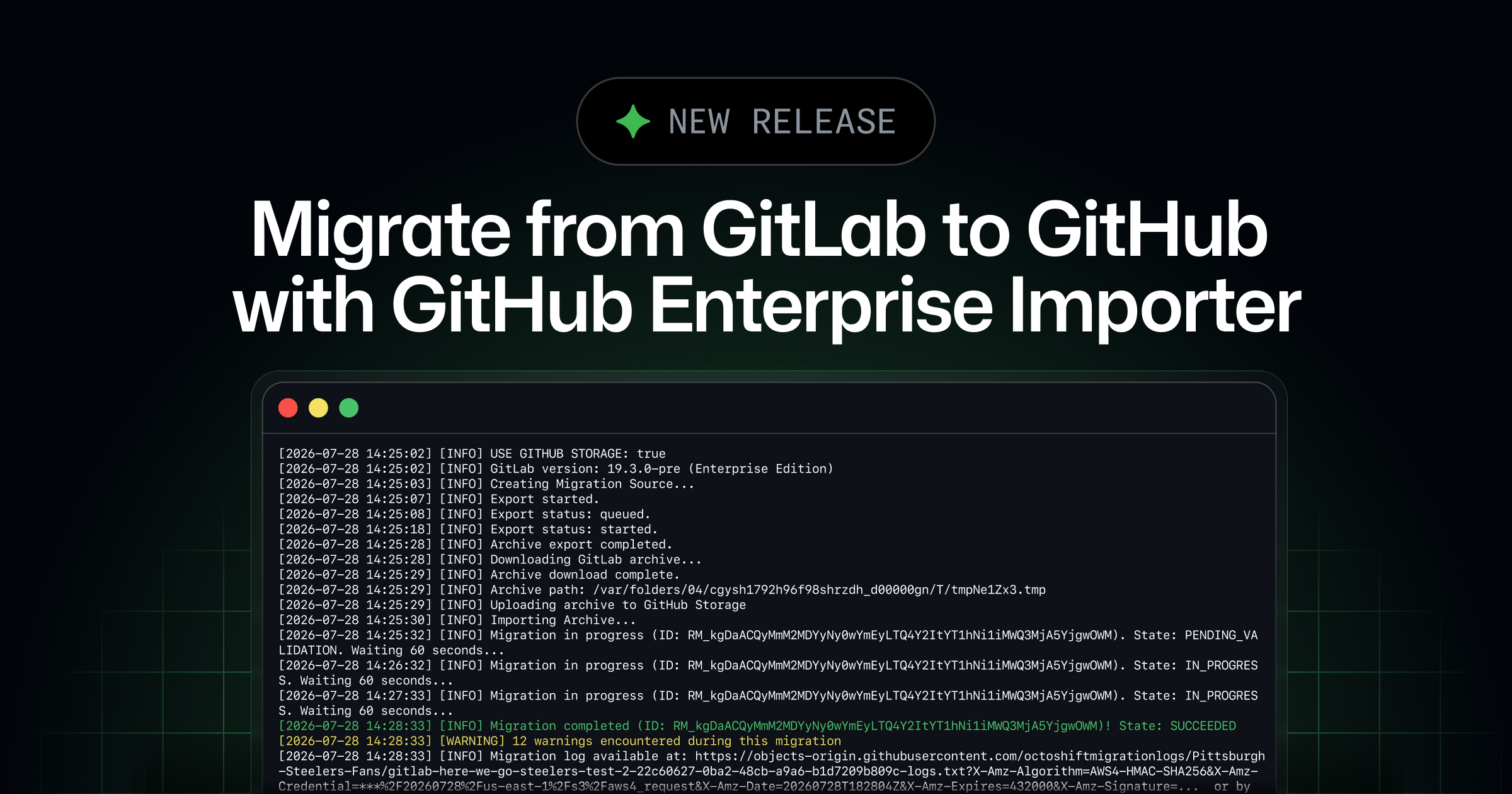
GitHub Enterprise ImporterによるGitLabからGitHubへの移行が一般提供開始Migrate from GitLab to GitHub with GitHub Enterprise Importer
匿名の公開いいねです。記事の保存・お気に入りではなく、Featured、Top 3、重要度、掲載順位には影響しません。仕組みとプライバシーAnonymous public likes are reactions, not saved articles or bookmarks. They do not affect Featured, Top 3, importance, or listing order.How it works and privacy
gitlab.comおよびGitLab Self-ManagedからGitHub Enterprise Cloudへの移行が、GitHub Enterprise Importer(GEI)を使ってセルフサービスで実施できるようになり、一般提供が開始された。
Migrations from gitlab.com and GitLab Self-Managed to GitHub Enterprise Cloud via GitHub Enterprise Importer are now generally available, enabling teams to self-serve repository migrations without manual assistance.
要約と収集メタデータをもとに生成した AI 解説本文です。元記事全文の転載・翻訳ではありません。This AI explainer is generated from the summaries and collected metadata, not from a reproduction or translation of the full source article.
GitHubは、GitHub Enterprise Importer(GEI)を用いたGitLabからGitHub Enterprise Cloudへの移行を一般提供(GA)として提供開始したと、changelogで告知した。これまで手作業の支援を前提としていた移行作業を、利用者自身がセルフサービスで実施できるようになった点が今回の要点である。
対象となるのは、SaaS版であるgitlab.comと、自社環境で運用するGitLab Self-Managedの双方から、GitHub Enterprise Cloudへの移行だ。抜粋によれば、GEIとgh(GitHubのコマンドライン向けツールと見られる)を組み合わせることで、リポジトリの移行を自分たちのタイミングで進められるようになる。専門チームへの依頼を待つ必要が減り、移行計画をより自律的に立てやすくなる可能性がある。
GitHub Enterprise Importerは、もともと他のプラットフォームからGitHubへリポジトリや関連データを移す目的で提供されてきた移行ツールである。これまでもAzure DevOpsやBitbucket Server、他のGitHub環境からの移行などで用いられてきた経緯があり、今回のGitLab対応のGA化は、その対応元をさらに広げる動きと位置づけられる。プレビュー段階を経て一般提供に至ったことで、本番環境での利用を想定した安定性が一定程度担保されたと受け取る組織もあるだろう。
背景として、開発プラットフォームの選定や統合は、企業のツールチェーン再編やM&Aに伴うシステム統合の局面でしばしば課題となる。GitLabとGitHubはいずれもGitベースのリポジトリ管理に加え、CI/CDやコードレビュー、Issue管理などを包含する統合プラットフォームであり、両者の間には機能面での重複と差異が存在する。そのため、移行にあたってはリポジトリ本体だけでなく、パイプライン定義や権限設定、履歴データの扱いなど、周辺要素をどこまで引き継げるかが実務上の焦点になりやすい。
セルフサービス化は移行の主導権を利用者側に移す一方で、事前検証や段階的な移行計画の重要性は引き続き残ると見られる。GitLabからの乗り換えや併用を検討している組織にとっては、GEIが選択肢の一つとして具体化した意味は小さくない。実際の適用範囲や制約については、GitHubの公式ドキュメントで最新情報を確認することが望ましい。
GitHub has announced that migrations from GitLab to GitHub Enterprise Cloud using the GitHub Enterprise Importer (GEI) are now generally available. According to the company's changelog, this covers both gitlab.com, the hosted service, and GitLab Self-Managed, the version organizations run on their own infrastructure. The change matters because it gives teams a supported, self-service path to move repositories between two of the most widely used code-hosting platforms, reducing reliance on manual scripting or hands-on assistance from GitHub during a transition.
At the core of the announcement is the shift from a preview or limited-availability status to general availability. General availability typically signals that a feature is considered stable enough for production use and is backed by standard support commitments, which is an important consideration for enterprises planning migrations that involve large volumes of source code and history. The changelog emphasizes that customers can now self-serve these migrations, meaning administrators can initiate and manage the process themselves rather than coordinating a bespoke engagement.
The GitHub Enterprise Importer is GitHub's tooling for moving work into GitHub Enterprise Cloud, and it is generally driven through the GitHub CLI, referred to as gh, using a dedicated migration extension. In practice, that means a team preparing to move from GitLab would authenticate against both the source and destination, configure the appropriate credentials, and run migration commands to transfer repositories into their GitHub Enterprise Cloud organization. This command-line approach is designed to make migrations repeatable and scriptable, which is useful when an organization needs to move many repositories in batches rather than one at a time.
It is worth being precise about scope. The announcement specifically describes repository migrations from GitLab sources into GitHub Enterprise Cloud. GitLab and GitHub differ in how they model certain features, so organizations evaluating a move should verify which artifacts transfer automatically and which may require additional planning. Historically, GEI migrations focus on Git repository content and history, and the mapping of surrounding metadata, permissions, and CI configuration can vary by source platform. Teams that rely heavily on GitLab CI/CD pipelines, for example, would likely need to plan separately for translating that automation into GitHub Actions, since pipeline definitions and runner configurations do not have a one-to-one equivalent across the two systems.
This GitLab support fits into a broader pattern for GEI, which already serves as the migration entry point for several other origins. GitHub has offered GEI-based paths from Azure DevOps and from other GitHub environments, and it maintains separate tooling for on-premises scenarios. By adding GitLab as a generally available source, GitHub extends the importer's reach to a competitor's user base, which appears aimed at customers who are consolidating tooling or standardizing on GitHub Enterprise Cloud. The move also aligns with the destination being the cloud-hosted enterprise offering rather than GitHub Enterprise Server, the self-hosted product, so organizations targeting on-premises GitHub would need to confirm the supported migration routes for that setup.
For context, migrations of this kind are often part of larger platform decisions rather than isolated technical tasks. Enterprises weighing a change frequently consider identity and access management, integration with existing DevOps toolchains, security and compliance features, and the cost implications of licensing across platforms. GitHub Enterprise Cloud brings its own ecosystem, including GitHub Actions for automation, Advanced Security features, and integration with Microsoft's broader developer and cloud services following GitHub's ownership by Microsoft. A self-service GitLab importer lowers one of the practical barriers to switching by making the repository transfer step more predictable.
Organizations planning to use the newly generally available path should still approach a migration methodically. Common prerequisites include ensuring administrators have the necessary roles on both platforms, checking repository sizes and any storage limits, and running trial migrations against a subset of repositories before committing to a full cutover. Because the process is now self-serve and driven through the gh CLI, teams can validate their approach in stages and adjust before moving production workloads.
In summary, the general availability of GitLab-to-GitHub Enterprise Cloud migrations through GitHub Enterprise Importer gives customers a documented, self-directed way to relocate repositories from both gitlab.com and GitLab Self-Managed. While the tooling streamlines the transfer itself, a complete transition is likely to involve additional planning around automation, permissions, and workflow parity, and organizations should consult GitHub's migration documentation to confirm exactly what is supported for their configuration.
本ページの本文と要約は AI による自動生成です。日本語版と英語版は言語ごとに独立して生成されるため、表現や詳しさが異なる場合があります。正確性は元記事 (github.blog) をご確認ください。The body and summaries are AI-generated independently for each language, so wording and detail may differ. Verify accuracy at the original source (github.blog).