エンタープライズアカウントにサードパーティ製 GitHub Apps をインストール可能にEnterprises can now install third-party GitHub Apps
匿名の公開いいねです。記事の保存・お気に入りではなく、Featured、Top 3、重要度、掲載順位には影響しません。仕組みとプライバシーAnonymous public likes are reactions, not saved articles or bookmarks. They do not affect Featured, Top 3, importance, or listing order.How it works and privacy
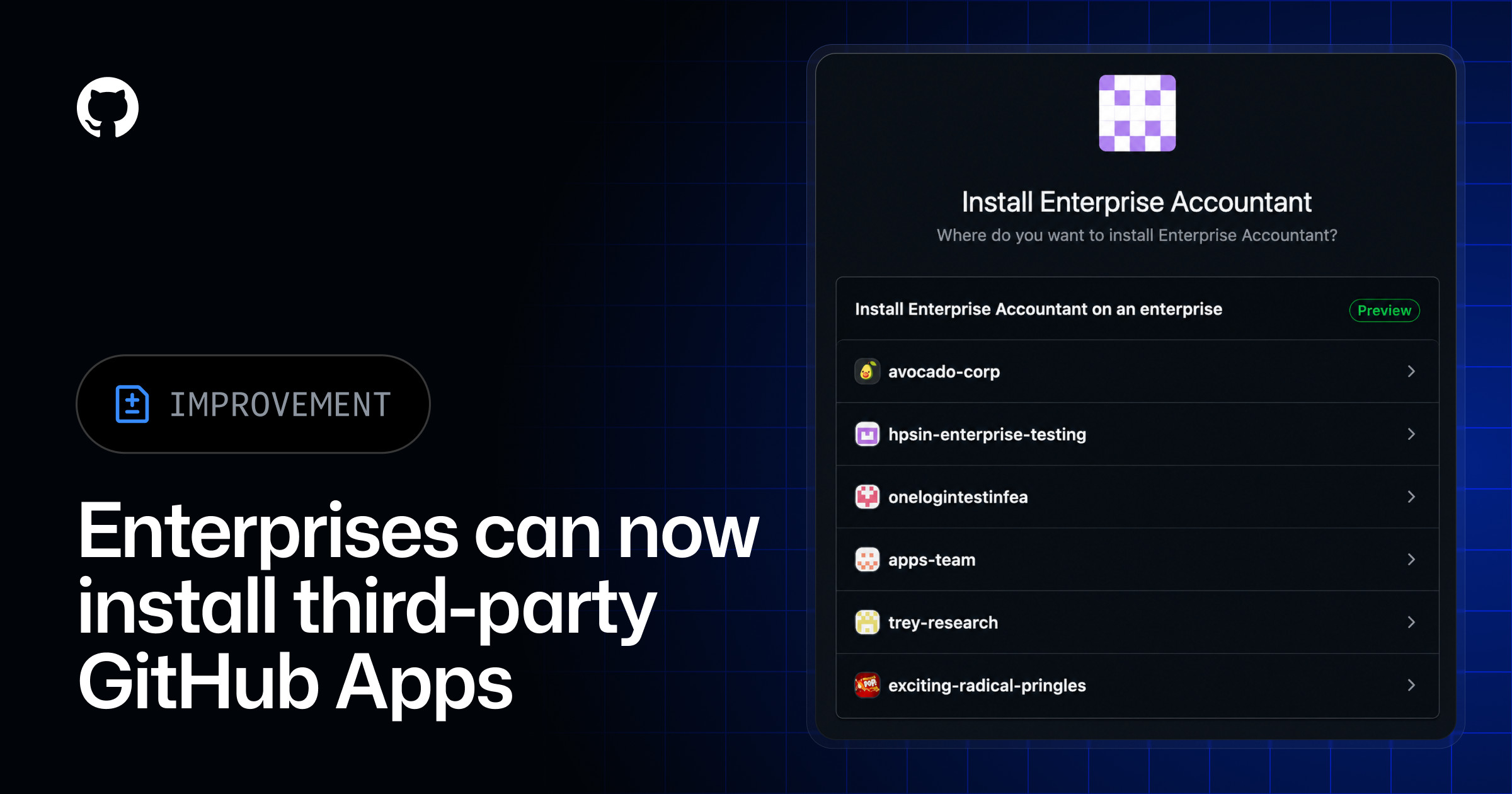
Enterprise オーナーが自社外で作成された公開 GitHub Apps をエンタープライズアカウントに直接インストールできるようになり、サードパーティ開発者がエンタープライズ管理向けアプリを提供しやすくなった。
GitHub now allows enterprise owners to install public third-party GitHub Apps at the enterprise level, enabling integrators to build and deliver apps targeting enterprise management scenarios.
要約と収集メタデータをもとに生成した AI 解説本文です。元記事全文の転載・翻訳ではありません。This AI explainer is generated from the summaries and collected metadata, not from a reproduction or translation of the full source article.
GitHub は、エンタープライズオーナーが自社外で作成された公開 GitHub Apps を、エンタープライズアカウントへ直接インストールできる新機能を公開した。サードパーティの開発者が、エンタープライズ管理向けのアプリを構築して提供しやすくなる点が大きな変化だ。
GitHub Apps は、GitHub プラットフォーム上で動作する連携アプリケーションの仕組みで、アプリ単位の認証ときめ細かな権限設定を通じて、リポジトリや Issue、Pull Request などの操作を自動化できる。従来こうしたアプリは主に組織(Organization)やリポジトリの単位でインストールされてきたが、今回の変更により、より上位の管理階層であるエンタープライズアカウントに対しても、外部で作成された公開アプリを導入できるようになった。
エンタープライズアカウントは、複数の組織を束ねて統合的に管理するための単位であり、ポリシーの適用やメンバー管理、監査といった全社的な運用を担う。ここにサードパーティ製アプリを組み込めるようになることで、エンタープライズ規模の管理業務を自動化・効率化するツールを、外部のインテグレーターが開発・提供する道が開かれる。
これまで GitHub は、Marketplace を通じたアプリ配布や、細かなアクセス制御を備えた GitHub Apps の枠組みを整えることで、企業向けの拡張性を高めてきた。今回の対応はその延長線上にあり、自社内で作成したアプリに加えて、外部の公開アプリもエンタープライズ層で活用できるようにした点が特徴といえる。
大規模組織ほどエンタープライズ管理には手作業の負担が生じやすく、外部ベンダーによる専用アプリの選択肢が増えれば、運用の柔軟性が高まる可能性がある。一方で、上位階層に外部アプリを導入する際には、インストール時に付与される権限の範囲やセキュリティ面の確認が、これまで以上に重要になると見られる。
GitHub has expanded where third-party GitHub Apps can be installed, allowing enterprise owners to add public apps built outside their own enterprise directly to their enterprise account. According to the company's changelog, this change opens enterprise-level installation to external integrators, giving them a supported path to build tools aimed specifically at enterprise management scenarios. For large organizations that centralize policy, membership, and security controls at the enterprise tier, the update matters because it extends the automation and integration model they already use at the repository and organization levels.
To understand the significance, it helps to recall how GitHub Apps have traditionally worked. GitHub Apps are the platform's recommended way to build integrations, acting as first-class actors with their own identity, granular permissions, and webhook subscriptions rather than relying on a personal account or a broad OAuth token. Historically, these apps were installed on individual organizations or user accounts, where they could be scoped to specific repositories and granted only the permissions they needed. Enterprise accounts, by contrast, sit above organizations and are used to manage settings, billing, members, and security policies across many organizations at once. Until now, the ability to install a third-party app at that top level was limited, which constrained the kinds of centralized tooling outside developers could offer.
The changelog states that enterprise owners can now install public GitHub Apps created outside their enterprise on their enterprise account, and that this enables third-party integrators to build apps for enterprise management scenarios. In practice, this appears to let vendors and internal platform teams create apps that operate against enterprise-scoped APIs and settings, rather than requiring administrators to stitch together per-organization installations or fall back to less secure credential-sharing approaches. The company notes that enterprise installations grant access at that level, meaning the permissions and reach of an app installed on an enterprise account are likely to differ from those of an app installed on a single organization. Because the excerpt is truncated, the precise scope of what enterprise installations grant is best confirmed in GitHub's own documentation before deployment.
For administrators, the change is likely to be relevant to governance, compliance, and identity workflows. Enterprise-level tooling commonly touches areas such as auditing, member and team provisioning, policy enforcement, license and seat management, and security configuration across every organization under the enterprise umbrella. By allowing external apps at this tier, GitHub gives specialized vendors, security firms, and consultancies a cleaner integration surface, and it gives customers a more standardized way to adopt those tools. It also fits a broader industry pattern in which platform providers push identity, policy, and automation controls upward to a central management layer so that decisions can be applied consistently at scale.
There are practical considerations that accompany any broadening of installable third-party software. Because enterprise accounts govern sensitive settings, the vetting of an app's requested permissions becomes important, and organizations may want to review what an app can read or change before approving it. GitHub's app model is designed to support least-privilege access through fine-grained permissions, and enterprise owners typically retain the ability to review, approve, and remove installations. As with any integration that operates at a high level of privilege, the security posture depends on both the app developer's practices and the customer's own approval and monitoring processes.
This update also sits alongside adjacent parts of the GitHub ecosystem. Developers distribute apps through channels including the GitHub Marketplace, and the platform continues to evolve features tied to enterprise administration, single sign-on, and audit logging. The move appears aimed at reducing friction for integrators who previously had to target organizations individually, and it may encourage a wider catalog of tools built specifically for enterprise operators rather than individual developers or teams. Organizations evaluating the feature should confirm availability for their plan, since capabilities that reference enterprise accounts are generally associated with GitHub Enterprise offerings, and should test any new installation in a controlled way. As always with changelog announcements, the full behavior, permission scopes, and any regional or plan-specific limitations are best verified against GitHub's current documentation.
本ページの本文と要約は AI による自動生成です。日本語版と英語版は言語ごとに独立して生成されるため、表現や詳しさが異なる場合があります。正確性は元記事 (github.blog) をご確認ください。The body and summaries are AI-generated independently for each language, so wording and detail may differ. Verify accuracy at the original source (github.blog).