HomeIndustry & Policy組織レベルでプルリクエストの上限数を設定可能に
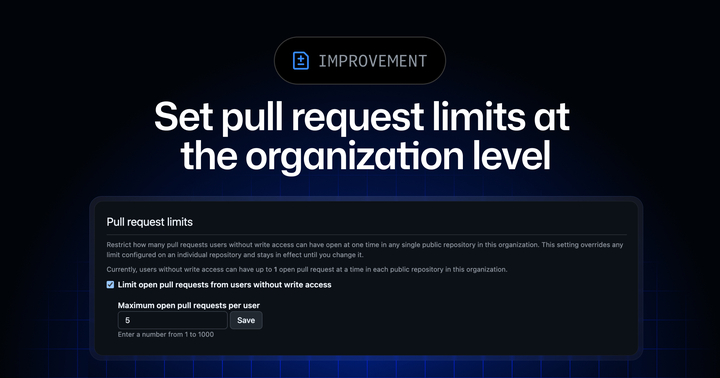
Set pull request limits at the organization level

組織レベルでプルリクエストの上限数を設定可能にSet pull request limits at the organization level

AI2 点サマリ2 key points
  • GitHub で組織レベルのプルリクエスト制限が設定できるようになり、書き込み権限のないユーザーが同時に開けるPR数を管理者が制御できる。
  • リポジトリ単位ではなく組織全体で一括管理できる点が利便性向上につながる。
  • GitHub now allows admins to configure pull request limits at the organization level, controlling how many open PRs a user without write access can have at once.
  • This enables consistent policy enforcement across all repositories in an organization.

要約と収集メタデータをもとに生成した AI 解説本文です。元記事全文の転載・翻訳ではありません。This AI explainer is generated from the summaries and collected metadata, not from a reproduction or translation of the full source article.

GitHubは、組織(Organization)単位でプルリクエスト(PR)の上限数を設定できる機能を追加した。書き込み権限を持たないユーザーが同時に開けるPRの数を、管理者が組織全体で一括して制御できるようになり、公開リポジトリを多く抱える組織での運用管理に役立つと見られる。

プルリクエスト制限は、書き込み権限のないユーザーが同時に開いておけるPRの数を定義する仕組みだ。GitHubの公式ブログ(The GitHub Blog)で告知された今回の変更により、これまで個別に管理していた設定を組織レベルでまとめて指定できるようになった。傘下の各リポジトリに横断的なポリシーを適用できる点が特徴で、リポジトリごとに設定して回る手間を省ける可能性がある。

この種の制限は、主に外部からの貢献を受け付ける公開リポジトリで意味を持つ。オープンソースプロジェクトなどでは、書き込み権限を持たない不特定多数のユーザーがPRを送れるため、短時間に大量のPRが作成されると、レビュー担当者やメンテナーの負担が増したり、通知が埋もれたりすることがある。上限を設けることで、一人のユーザーが同時に抱えられるPR数を抑え、こうした状況を緩和する狙いがあると考えられる。

GitHub で組織レベルのプルリクエスト制限が設定できるようになり、書き込み権限のないユーザーが同時に開けるPR数を管理者が制御できる。
📰 Industry & Policy · 本記事のポイント

GitHubはこれまでも、アクセス制御やモデレーションに関する機能を段階的に拡充してきた。ブランチ保護やリポジトリのルールセットといった既存の仕組みと組み合わせることで、組織はより一貫した運用ポリシーを構築しやすくなる。今回の組織レベル対応は、そうした管理機能を組織全体の視点で扱えるようにする流れの一環と位置づけられる。

一方で、上限値の具体的な設定範囲や適用対象の詳細、既存のリポジトリ単位設定との関係については、実際の管理画面やドキュメントを確認する必要がある。正当な貢献者が想定外に制限を受けないよう、値の設定には運用状況に応じた調整が求められそうだ。

GitHub has introduced the ability for administrators to set pull request limits at the organization level, extending a control that governs how many open pull requests a contributor without write access can have at any one time. The change matters because it gives organization owners a single place to enforce a policy that previously had to be considered repository by repository, reducing administrative overhead for teams that manage many projects.

At its core, the feature governs a specific slice of contributor activity. A pull request limit defines the maximum number of open pull requests that a user without write access to a repository is allowed to have simultaneously. Contributors with write access are not affected, so the setting is aimed at outside collaborators, forkers, and other participants who submit changes without being formal members of a repository's team. Once the ceiling is reached, an affected user would generally need an existing pull request to be merged or closed before opening another.

The headline improvement here is scope. Administrators can now apply the limit across an entire organization rather than configuring it for each repository individually. For organizations that host dozens or hundreds of repositories, this appears designed to make policy enforcement more consistent and less error-prone, since a single organization-level setting can cascade to covered repositories rather than relying on per-repository configuration that can drift over time.

The move fits within GitHub's broader access-control tooling, which has expanded steadily in recent years. Organization owners already manage repository roles, branch protection rules, and the newer repository rulesets, which let teams codify requirements such as required reviews or status checks. Pull request limits sit alongside these mechanisms as a guardrail focused less on code quality gates and more on controlling the volume of inbound contributions from accounts that have not been granted write privileges.

The practical motivation is likely tied to abuse and spam management. Public repositories, and popular open-source projects in particular, periodically face waves of low-value or automated pull requests. Events that reward contributions have historically triggered surges of spam pull requests, and maintainers have long asked for tools to blunt that pressure without closing their projects to legitimate outside help. A cap on simultaneous open pull requests from non-write users offers a blunt but useful lever: genuine contributors are rarely affected because they typically maintain only a small number of active pull requests, while accounts attempting to flood a project hit a ceiling quickly.

GitHub now allows admins to configure pull request limits at the organization level, controlling how many open PRs a user without write access can have at once.
📰 Industry & Policy · Key takeaway

The timing also intersects with a broader industry shift toward automated and AI-assisted contributions. As coding agents and bots become more capable of generating and submitting changes at scale, the ability to limit how many open pull requests an unprivileged account can maintain may become a more meaningful defense for maintainers trying to keep review queues manageable. GitHub has not framed the feature specifically as an anti-bot measure in the material available, so that connection should be read as context rather than a stated purpose.

For administrators, the addition is incremental rather than transformative, but it addresses a real operational gap. Managing a setting once at the organization level, instead of repeating it across every repository, aligns with how many teams already prefer to handle security and governance policies. It also reflects a pattern GitHub has followed with other controls, gradually promoting repository-scoped settings to organization scope so that governance can be centralized.

Teams considering the setting will want to weigh the trade-off between friction and openness. Setting a limit too low could discourage prolific external contributors or complicate workflows where a single person legitimately manages several parallel changes, while a more generous limit still curbs obvious abuse. As with most access-control features, the appropriate threshold depends on the organization's tolerance for inbound contribution volume and the review capacity its maintainers have available. Organizations that host large public projects are likely to find the organization-level option the most immediately useful, though private and internal teams may also value the consistency it brings to how contributions are handled across their repositories.

  • 出典SourceGitHub Changelog公式Official
  • 直近30件の平均重要度Avg importance, last 301=Info · 2=Medium · 3=High
  • 配信形式Format変更履歴Changelog
  • 重要度Importance重要度 MediumMedium priority(Industry & Policy 427件中、同等以上 318件)(318 of 427 Industry & Policy entries are equal or higher)
  • 情報の寿命Half-life⏱️ 短命 (ニュース)Short-lived (news)
  • 原文言語Source languageEN
  • 収集日時Collected2026/08/10 16:04

本ページの本文と要約は AI による自動生成です。日本語版と英語版は言語ごとに独立して生成されるため、表現や詳しさが異なる場合があります。正確性は元記事 (github.blog) をご確認ください。The body and summaries are AI-generated independently for each language, so wording and detail may differ. Verify accuracy at the original source (github.blog).

📰Industry & Policy の他の記事More from Industry & Policyもっと見る →View more →