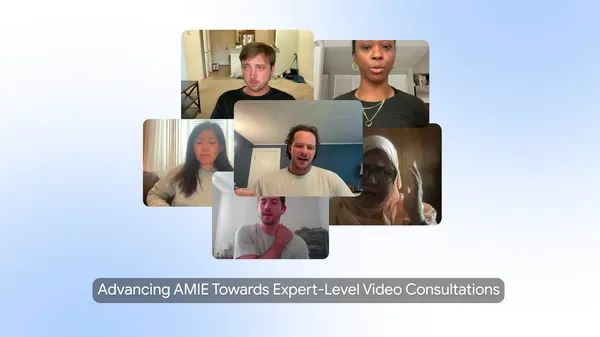
Googleの医療AI「AMIE」、リアルタイム臨床ビデオ診察機能を初の研究で実証AMIE, our research medical AI system, demonstrates real-time clinical video consultation capabilities in a first-of-its-kind study.
匿名の公開いいねです。記事の保存・お気に入りではなく、Featured、Top 3、重要度、掲載順位には影響しません。仕組みとプライバシーAnonymous public likes are reactions, not saved articles or bookmarks. They do not affect Featured, Top 3, importance, or listing order.How it works and privacy
- GoogleはAMIEがシミュレーション環境でリアルタイムのビデオ診察を行える能力を持つことを初めて実証した。
- 医療AIが実際の診察形式に対応できる可能性を示す重要な研究成果。
Google demonstrated that its AMIE research AI can conduct real-time clinical video consultations in simulated settings, marking a significant step toward AI-assisted medical consultations.
本ページの本文と要約は AI による自動生成です。日本語版と英語版は言語ごとに独立して生成されるため、表現や詳しさが異なる場合があります。正確性は元記事 (blog.google) をご確認ください。The body and summaries are AI-generated independently for each language, so wording and detail may differ. Verify accuracy at the original source (blog.google).
要約と収集メタデータに基づく AI 解説。元記事全文の転載・翻訳ではありません。AI explainer based on the summaries and collected metadata, not a copy or translation of the full source article.
Googleは、同社が研究開発を進める医療AI「AMIE」が、シミュレーション環境においてリアルタイムのビデオ診察を実施できることを初めて実証したと発表した。テキストベースの対話にとどまらず、映像を介した実際の診察に近い形式へと対応の幅を広げる可能性を示す研究成果として注目される。
AMIE(Articulate Medical Intelligence Explorer)は、大規模言語モデルを基盤とするGoogleの医療対話向け研究プロジェクトである。これまでは主にテキストによる問診や鑑別診断の対話能力が示されてきたが、今回の研究では、患者役とのビデオ通話を通じてリアルタイムに情報をやり取りしながら診察を進める能力が検証された。映像を扱えるようになることで、言葉だけでは伝わりにくい所見や状況を踏まえた対応が可能になると見られる。
今回の成果はあくまでシミュレーション環境での実証であり、実際の患者を対象とした臨床利用を意味するものではない点には注意が必要だ。医療分野のAIは診断や説明の正確性、安全性、責任の所在など慎重な検証が求められる領域であり、研究段階から実用化までには規制対応を含む多くの段階が想定される。
医療向けAIをめぐっては、MicrosoftやOpenAIなど各社も大規模言語モデルの臨床応用に向けた取り組みを進めており、テキストから音声、映像へとマルチモーダル化が進む流れにある。Googleはこれまでにもヘルスケア領域でAI研究を重ねてきた経緯があり、今回のビデオ診察の実証は、AIが対面に近い形で医療コミュニケーションを支援できる可能性を探る一歩と位置づけられる。実際の医療現場での有用性については、今後さらなる研究や評価の積み重ねが求められそうだ。
Google has demonstrated for the first time that AMIE, its experimental medical artificial intelligence system, can conduct real-time clinical consultations over video in simulated settings. The result matters because it pushes the system beyond text-based chat and closer to the format in which many patients actually meet clinicians today, offering an early signal of how conversational AI might one day support remote or telehealth-style care.
AMIE, short for Articulate Medical Intelligence Explorer, is a research effort from Google focused on diagnostic dialogue rather than one-shot answers. Earlier work centered on typed conversations, in which the system gathered a patient's history, asked follow-up questions, reasoned about possible causes, and proposed a differential diagnosis and next steps. Those studies were run in controlled, simulated environments and evaluated using formats modeled on the Objective Structured Clinical Examination (OSCE), a standardized method medical schools use to assess trainees through interactions with actors playing patients. The new study extends that approach into live video, where the exchange unfolds in real time rather than through asynchronous text.
Moving to real-time video introduces technical demands that text does not. A system must manage the natural rhythm of spoken or live conversation, including turn-taking, interruptions, and pacing, while keeping latency low enough to feel responsive. It also opens the door to visual information that a chat interface cannot capture, such as a patient's appearance or a visible physical sign. Google's description frames this as a demonstration that AMIE can operate in this consultation format, which is a meaningful engineering and design milestone even though the work appears to remain confined to simulated scenarios rather than encounters with real patients.
It is worth being precise about what has and has not been shown. According to the source material, the study establishes that AMIE can carry out real-time clinical video consultations in simulated settings, marking a step toward AI-assisted medical consultations. That is different from a clinically validated tool, a regulatory clearance, or a deployed product. Research demonstrations like this typically measure how the system performs against defined benchmarks and, in some cases, against human clinicians on specific conversational or diagnostic metrics, but results from simulations do not automatically transfer to the complexity, liability, and safety requirements of real-world medicine. The appropriate reading is that this is likely an incremental but notable advance within an ongoing research program.
The broader context helps explain why Google is investing here. AMIE builds on the company's earlier medical AI work, including research systems such as Med-PaLM that were evaluated on medical question answering, and it reflects a wider industry push to apply large language models and multimodal models to healthcare tasks. Prior AMIE research has also explored multimodal capabilities, such as interpreting medical images alongside conversation, so adding a real-time video channel fits a trajectory toward systems that can both talk and perceive. Google's medical models are generally associated with its Gemini family of foundation models, and the company has repeatedly emphasized that these are research investigations conducted with clinical input rather than consumer products.
Other technology and health organizations are pursuing adjacent goals, from clinical documentation assistants that transcribe and summarize visits to diagnostic support tools and AI scribes now being piloted in hospital systems. Telehealth adoption, which expanded significantly in recent years, provides a plausible setting in which conversational and video-based AI could eventually play a supporting role, for example in triage, intake, or follow-up. At the same time, medical AI faces persistent challenges that this study alone does not resolve, including the risk of confidently stated errors, gaps in handling rare or atypical presentations, questions of bias across patient populations, privacy and data governance, and the regulatory frameworks that govern software used in diagnosis or treatment.
For now, AMIE's real-time video capability is best understood as a research demonstration that widens the range of interaction formats the system can handle, not as evidence that AI is ready to replace clinicians. Whether the approach proves safe and useful in practice will depend on rigorous testing with real patients, independent evaluation, and oversight from medical and regulatory bodies, steps that typically take considerable time.
ポコとTECHガイドPoko & TECH Guide
ポコと当サイトのTECHガイドが、記事の要約と収集した情報から読みどころを語るAI生成の対話です。Poko and TECH Dashboard's own TECH Guide discuss the article's highlights in an AI-generated conversation based on its summary and collected source details.
- ポコPokoAMIEがリアルタイムでビデオ診察できたって、つまりどういうこと?AMIE handled a video consultation in real time—what does that actually mean?
- TECHガイドTECH Guide簡単に言うとじゃな、記事によればAMIEは模擬環境で、映像を使った診察形式にその場で対応する能力を示したんじゃよ。Put simply, the article says AMIE demonstrated that it could handle a video-based clinical consultation on the spot in a simulated setting.
- ポコPokoへえ、すごい! それって医療では何がうれしいの?Wow, that sounds impressive! What could make this useful in healthcare?
- TECHガイドTECH Guide記事が示すのは、医療AIが実際の診察に近い形式へ対応できる可能性じゃ。AIが診察を支援する方向への重要な一歩とされておるよ。The study suggests medical AI may be able to work in a format resembling real consultations. The article presents it as an important step toward AI-assisted care.
- ポコPokoつまりAMIEは、文章だけでなくリアルタイムのビデオ診察にも対応できる可能性を見せたんだね。So AMIE showed that it may be able to handle real-time video consultations, not just text-based interactions.
- TECHガイドTECH Guideその理解でよいぞ。とはいえ今回は模擬環境での研究じゃから、今後どこまで実際の診察につながるかが見どころじゃな。That’s right. Still, this was a study in a simulated setting, so the key question is how far it might translate to real clinical consultations.