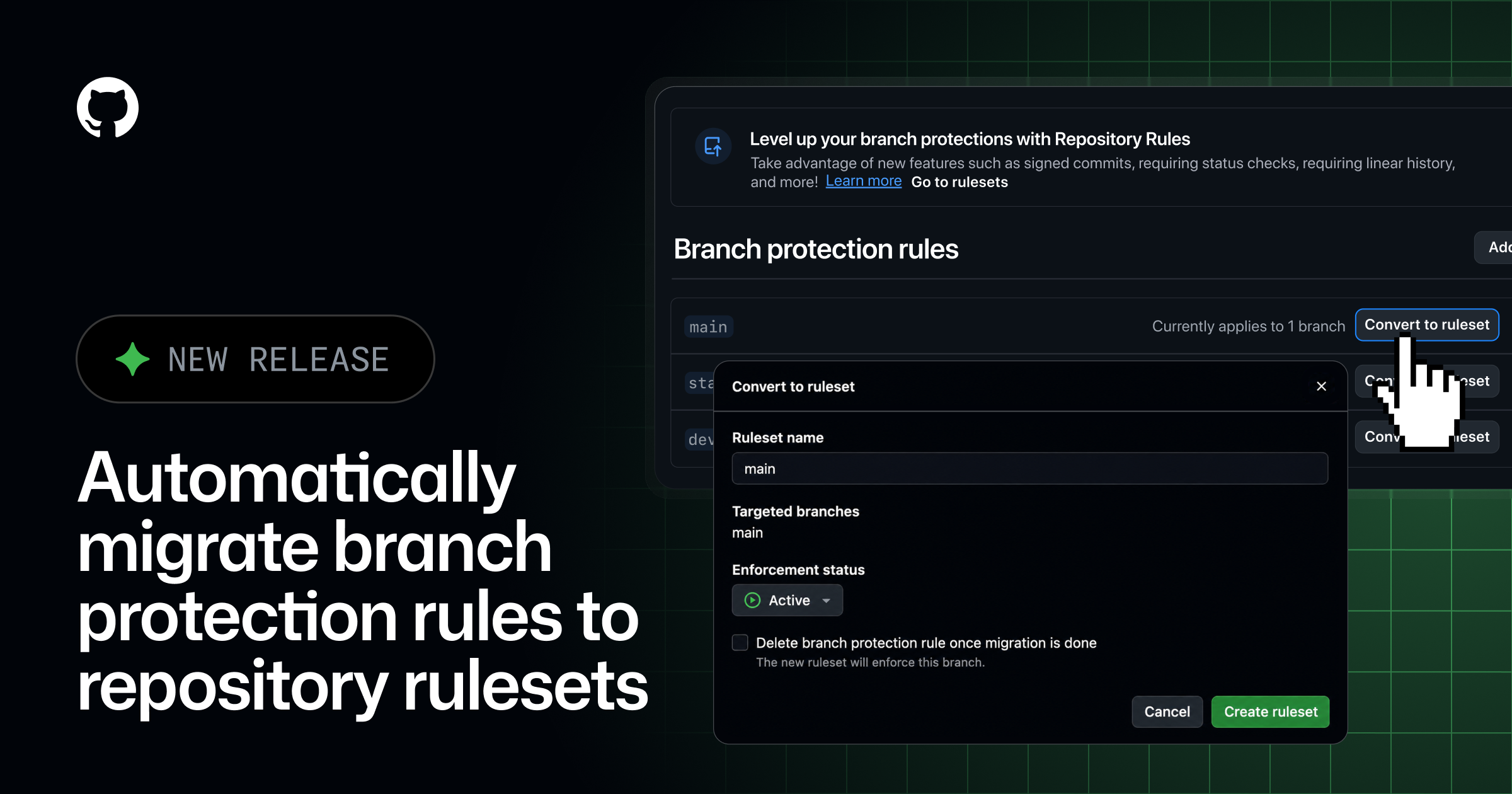
ブランチ保護ルールをリポジトリルールセットへ自動移行できるようにAutomatically migrate branch protection rules to repository rulesets
匿名の公開いいねです。記事の保存・お気に入りではなく、Featured、Top 3、重要度、掲載順位には影響しません。仕組みとプライバシーAnonymous public likes are reactions, not saved articles or bookmarks. They do not affect Featured, Top 3, importance, or listing order.How it works and privacy
- GitHubのリポジトリ設定から、既存のブランチ保護ルールをリポジトリルールセットへ直接変換できるようになった。
- より柔軟でスケーラブルなポリシー管理への移行が容易になる。
GitHub now lets you convert existing branch protection rules to repository rulesets directly from repository settings, making it easier to adopt the more flexible and scalable ruleset framework.
要約と収集メタデータをもとに生成した AI 解説本文です。元記事全文の転載・翻訳ではありません。This AI explainer is generated from the summaries and collected metadata, not from a reproduction or translation of the full source article.
GitHubは、リポジトリの設定画面から既存のブランチ保護ルールをリポジトリルールセット(Repository Rulesets)へ直接変換できる機能を公開した。これまで手作業での再設定が必要だった移行を自動化し、より柔軟でスケーラブルなポリシー管理の枠組みへ乗り換えやすくする狙いがある。
ブランチ保護ルール(Branch Protection Rules)は、プルリクエストのレビュー必須化やステータスチェックの通過要求、特定ブランチへの直接プッシュ制限などを設定する従来型の仕組みで、多くのリポジトリで長く使われてきた。一方のリポジトリルールセットは、GitHubが比較的新しく導入したポリシー管理の枠組みで、複数のルールを重ねて適用できる点や、対象のブランチ・タグをパターンで柔軟に指定できる点などが特徴とされる。
今回の変更により、リポジトリ管理者は設定内から既存のブランチ保護ルールをルールセットへ変換でき、ゼロから作り直す手間を省ける。GitHubは抜粋の中で、この機能が「より柔軟でスケーラブルなポリシーの枠組み」への移行を助けると説明している。
GitHubのリポジトリ設定から、既存のブランチ保護ルールをリポジトリルールセットへ直接変換できるようになった。
背景には、GitHubがルールセットを新しい管理手段として位置づけを進めてきた経緯があると見られる。ルールセットは組織レベルでの一括適用や、適用状態(有効・評価・無効など)を切り替えながら段階的に導入する運用を想定した設計とされ、大規模なリポジトリ群を扱う組織での運用性が意識されている。従来のブランチ保護ルールと機能面で重なる部分が多く、両者が併存することで管理が複雑になるとの指摘もあった。
自動移行の提供は、こうした二重管理の解消や、既存設定を活かした段階的な移行を後押しする可能性がある。ただし移行後も、ルールの挙動や適用範囲が意図通りかを確認する運用は引き続き求められるだろう。ポリシー管理の一本化を検討するチームにとって、今回の変更は移行のハードルを下げる一歩になりそうだ。
GitHub has added a way to convert existing branch protection rules into repository rulesets directly from a repository's settings, giving teams a guided path off the platform's older policy mechanism. For organizations that have accumulated years of branch protection configuration, this matters because it removes much of the manual effort previously required to adopt rulesets, GitHub's more flexible and scalable framework for governing how code is merged and maintained.
Branch protection rules have long been the standard tool for enforcing quality and security controls on important branches such as main or release. They let maintainers require pull request reviews, mandate passing status checks, enforce signed commits, require linear history, and restrict who is allowed to push. These controls remain widely used, but they carry structural limitations. A branch protection rule applies to branches matching a single pattern, and only one rule can effectively govern a given branch at a time, which makes layering policies or coordinating rules across many repositories cumbersome.
Repository rulesets were introduced to address those constraints. Rulesets can target both branches and tags, support multiple named rulesets that apply simultaneously to the same ref, and include enforcement states so a policy can be set to active, disabled, or run in an evaluate mode that reports what would happen without blocking anyone. They also offer more granular bypass permissions, letting specific teams, roles, or apps be granted exceptions in a controlled way. Because rulesets can be defined at the organization level and pushed down to many repositories, they are generally better suited to enterprises trying to apply consistent policy at scale.
The new migration capability appears aimed squarely at closing the gap between these two systems. Rather than asking administrators to recreate each protection rule by hand and risk misconfiguring or weakening controls during the transition, the conversion tool takes existing branch protection settings and produces equivalent rulesets from within the repository settings interface. This lowers the barrier for teams that have hesitated to move because of the labor involved or the fear of introducing gaps in enforcement.
For administrators considering the switch, a few practical points are worth keeping in mind. Branch protection rules and rulesets can coexist on the same repository, and when both apply, GitHub evaluates all applicable rules together, with the most restrictive outcome typically taking effect. That means a careful migration can be staged rather than performed all at once, and the evaluate enforcement status offers a way to observe the impact of a converted ruleset before it begins blocking merges. Teams should still review the generated rulesets to confirm that targets, required checks, and bypass lists match their intent, since automated conversion reduces but does not eliminate the need for validation.
This change fits into a broader pattern of GitHub steering customers toward rulesets as the preferred governance model. Over the past few release cycles the company has expanded rulesets with additional rule types, organization-wide targeting, and integration with features such as required workflows and push protection. Positioning branch protection as the legacy approach and rulesets as the forward path is consistent with that direction, though GitHub has not, based on this announcement, indicated that branch protection rules are being deprecated or removed. The migration tool is best read as an on-ramp rather than a forced cutover.
The context also connects to adjacent parts of GitHub's policy and security tooling. Rulesets sit alongside features like CODEOWNERS for review routing, GitHub Advanced Security for scanning and secret detection, and Actions-based required checks, all of which contribute to how changes reach protected branches. Enterprises that manage many repositories through the API or infrastructure-as-code tools such as Terraform may also want to evaluate how converted rulesets are represented programmatically, since consistent tooling matters when policy is applied across hundreds or thousands of repositories.
For most teams, the immediate takeaway is straightforward. If you rely on branch protection today and have been weighing a move to rulesets, the conversion option in repository settings is likely to make that transition faster and less error-prone. As with any change to enforcement policy, testing the result on a non-critical branch and reviewing the generated configuration before broad rollout remains a sensible precaution.
本ページの本文と要約は AI による自動生成です。日本語版と英語版は言語ごとに独立して生成されるため、表現や詳しさが異なる場合があります。正確性は元記事 (github.blog) をご確認ください。The body and summaries are AI-generated independently for each language, so wording and detail may differ. Verify accuracy at the original source (github.blog).