Copilot クラウドエージェントの推論レベルをカスタマイズ可能にCustomize the reasoning level for Copilot cloud agent
匿名の公開いいねです。記事の保存・お気に入りではなく、Featured、Top 3、重要度、掲載順位には影響しません。仕組みとプライバシーAnonymous public likes are reactions, not saved articles or bookmarks. They do not affect Featured, Top 3, importance, or listing order.How it works and privacy
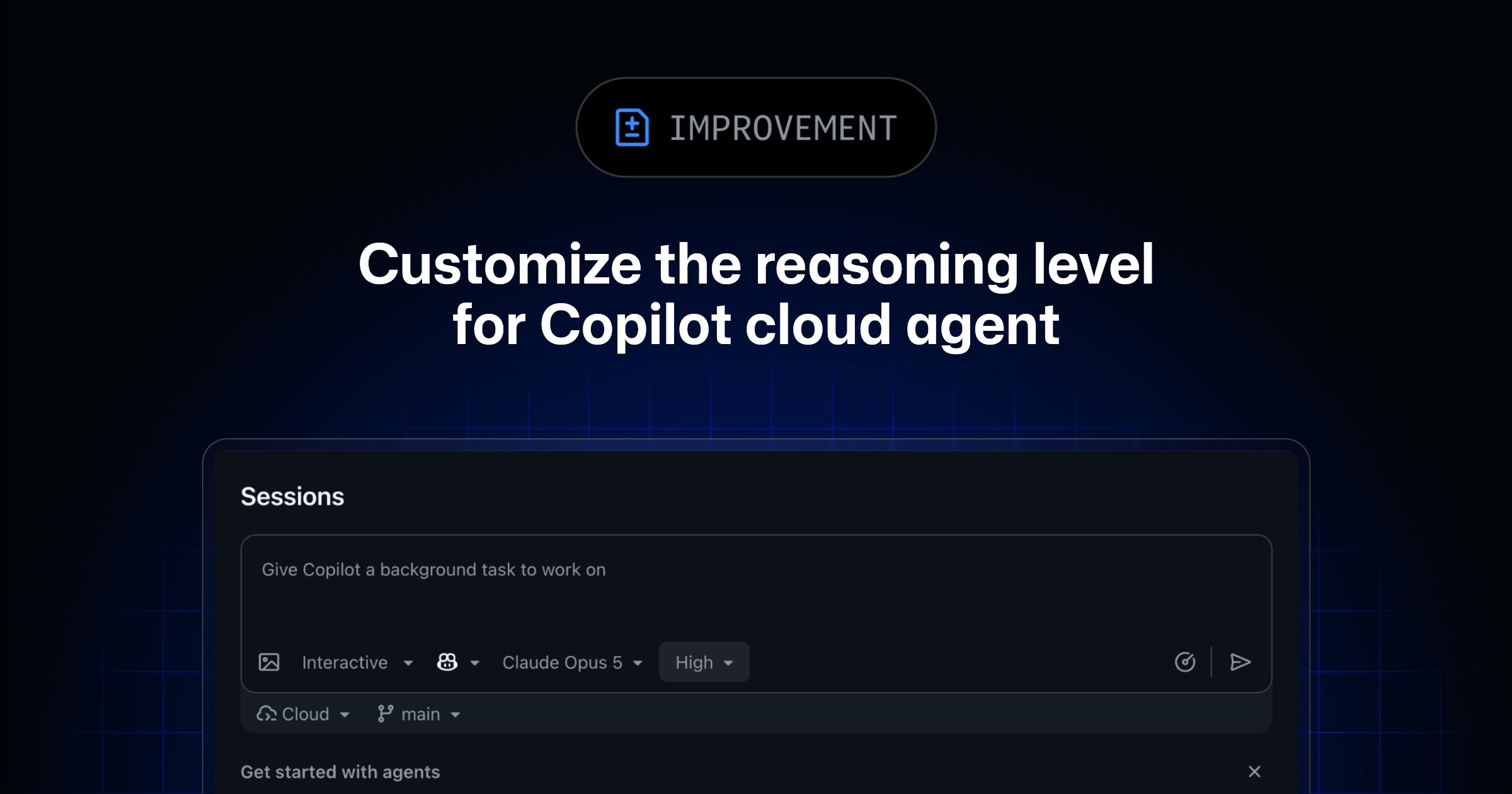
- GitHub Copilot クラウドエージェントにタスクを委任する際、対応モデルで推論レベルを設定できるようになった。
- これにより処理の深さをユーザーが制御できる。
GitHub Copilot cloud agent now lets users configure the reasoning level for supported models when delegating tasks, giving finer control over how deeply the agent thinks through problems.
要約と収集メタデータをもとに生成した AI 解説本文です。元記事全文の転載・翻訳ではありません。This AI explainer is generated from the summaries and collected metadata, not from a reproduction or translation of the full source article.
GitHub は、Copilot のクラウドエージェントにタスクを委任する際、対応するモデルの「推論レベル(reasoning level)」をユーザー自身で設定できるようにしたと、公式の changelog で明らかにした。エージェントがどの程度深く問題を考え抜くかを制御できる更新で、開発者が処理の粒度を自分の用途に合わせて調整できる点が特徴だ。
Copilot クラウドエージェントは、Issue への対応やコード変更といった作業をエージェントに任せ、バックグラウンドで進めてもらうための機能だ。今回の変更により、この委任時に対応モデルであれば推論レベルを選べるようになった。推論レベルとは、モデルが回答を導くまでにどれだけ思考のステップを費やすかを示す度合いを指すと見られる。
近年、いわゆる「推論(reasoning)モデル」は、回答前に内部で段階的に検討を重ねることで、複雑な課題への精度を高める方向で発展してきた。一方で、思考を深めるほど処理に時間がかかる傾向があり、単純なタスクでは軽い設定でも十分な場合がある。推論レベルを調整できることは、こうした深さと応答性のバランスをタスクごとに取り分けたいというニーズに応えるものと言える。
GitHub Copilot クラウドエージェントにタスクを委任する際、対応モデルで推論レベルを設定できるようになった。
たとえば、設計上の判断を伴う難しい実装では深い推論を、定型的な修正では浅い設定を、といった使い分けが想定される。ただし、対象は推論レベルの設定をサポートするモデルに限られる点には注意が必要だ。どのモデルが該当し、既定値がどう扱われるかは、実際の管理画面やドキュメントで確認することになる。
GitHub は Copilot について、モデル選択をはじめとするカスタマイズの幅を継続的に広げてきた経緯がある。今回の推論レベル制御も、その延長線上にある細やかな調整手段の一つと位置づけられる。エージェントによる自動化を実務へ組み込むうえで、精度と効率のどちらを優先するかをユーザー側で判断できる余地が増えることは、運用の柔軟性につながる可能性がある。
GitHub has introduced a new customization option for its Copilot cloud agent that lets developers set the reasoning level for models that support it when delegating a task. Announced through the GitHub changelog, the change gives users more direct control over how deeply the agent works through a problem before returning results. It matters because it moves a setting that was previously fixed or hidden into the hands of the person assigning the work, allowing teams to match the depth of the agent's analysis to the difficulty of each task.
The Copilot cloud agent is GitHub's asynchronous coding agent, designed to take on a delegated task and carry it out in the background rather than responding interactively in an editor. In practice this means a developer can hand off a piece of work and let the agent plan, make changes, and prepare the results for review without supervising each step. With this update, the delegation flow now includes an option to choose how much reasoning the underlying model applies, provided the selected model exposes that capability.
Reasoning level, sometimes described in the wider industry as reasoning effort, refers to how much intermediate "thinking" a model performs before it commits to an answer. Modern reasoning-oriented models can spend additional internal steps working through a problem, which tends to improve accuracy on complex, multi-step tasks such as debugging intricate logic or planning a larger refactor. That extra effort generally comes at a cost: deeper reasoning typically takes longer and consumes more compute. By making the level configurable, GitHub appears to be letting users decide where to sit on that trade-off, dialing up depth for hard problems and keeping things lighter for routine changes where speed is preferable.
A key qualifier in the announcement is that the setting applies only to models that support it. Copilot can be backed by different underlying models, and not all of them expose a reasoning control. As a result, the option is likely to appear or behave differently depending on which model is selected, and developers should expect the choice to be available only for compatible models rather than universally across every configuration.
The move fits a broader pattern across the AI tooling landscape, where model providers have begun surfacing reasoning controls as explicit parameters. Several leading model families now include a notion of adjustable reasoning effort, giving applications a way to balance quality, latency, and cost per request. GitHub exposing a similar control at the agent level is a natural extension of that trend, bringing a capability that was mostly the domain of API developers into a product workflow aimed at everyday software teams.
It also builds on GitHub's wider Copilot customization efforts. Over the past period, the company has added ways to shape how Copilot behaves, including custom instructions, repository-level configuration, and model selection, all intended to let organizations tailor the assistant to their codebases and conventions. Reasoning level customization is another lever in that toolkit, and it sits alongside related capabilities such as Copilot's agent mode in the editor and integrations that let the coding agent operate within existing repository and pull request workflows.
For teams evaluating how to use the feature, the practical guidance implied by the design is straightforward. Higher reasoning is likely to be most valuable for tasks with many moving parts or where correctness is critical, while lower settings may be sufficient, and faster, for well-scoped or repetitive work. Because the effect can vary by model and task, some experimentation will probably be needed to find the right default for a given project.
As with any changelog update, the exact behavior, available models, and any usage implications may continue to evolve, and GitHub's documentation and the original blog post remain the authoritative references for specifics. Still, the addition signals a continuing shift toward giving developers finer-grained control over how autonomous coding agents operate, rather than treating them as fixed black boxes. For organizations already relying on the Copilot cloud agent to offload work, the ability to tune reasoning depth is a modest but meaningful step toward aligning agent behavior with the varied demands of real development tasks.
本ページの本文と要約は AI による自動生成です。日本語版と英語版は言語ごとに独立して生成されるため、表現や詳しさが異なる場合があります。正確性は元記事 (github.blog) をご確認ください。The body and summaries are AI-generated independently for each language, so wording and detail may differ. Verify accuracy at the original source (github.blog).