新しいAIツールでマーケティングを進化させるEvolve your marketing with new AI tools
匿名の公開いいねです。記事の保存・お気に入りではなく、Featured、Top 3、重要度、掲載順位には影響しません。仕組みとプライバシーAnonymous public likes are reactions, not saved articles or bookmarks. They do not affect Featured, Top 3, importance, or listing order.How it works and privacy
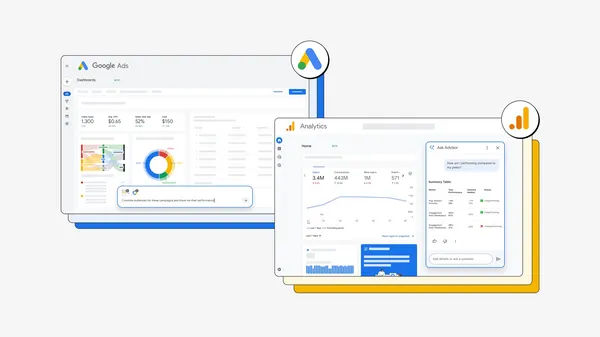
- GoogleはGoogle AdsとGoogle Analyticsにエージェント型AI機能を追加し、マーケターのワークフローを効率化する。
- これによりキャンペーン管理や分析作業の自動化が進む。
Google is rolling out new agentic AI features across Google Ads and Google Analytics to streamline marketing workflows, making campaign management and data analysis more automated and accessible.
本ページの本文と要約は AI による自動生成です。日本語版と英語版は言語ごとに独立して生成されるため、表現や詳しさが異なる場合があります。正確性は元記事 (blog.google) をご確認ください。The body and summaries are AI-generated independently for each language, so wording and detail may differ. Verify accuracy at the original source (blog.google).
要約と収集メタデータに基づく AI 解説。元記事全文の転載・翻訳ではありません。AI explainer based on the summaries and collected metadata, not a copy or translation of the full source article.
Googleは、広告運用の「Google Ads」とアクセス解析の「Google Analytics」に、新たなAIおよびエージェント型(エージェンティック)の機能を追加すると発表した。キャンペーンの管理やデータ分析といったマーケティング業務を自動化・簡素化し、担当者のワークフローを効率化する狙いがあると見られる。
エージェント型AIとは、単に質問へ回答するだけでなく、目標に沿って一連の作業を自律的に進める仕組みを指す。従来のチャット型AIが「聞かれたことに答える」段階だったのに対し、エージェント型では分析から施策の提案、実行までを一貫して支援できる点が特徴とされる。今回の機能強化により、マーケターは複雑な操作や専門的な分析を、より平易な形で扱える可能性がある。
Google Adsはこれまでも、目標に応じて配信を最適化する「P-MAX(Performance Max)」や自動入札などの自動化機能を段階的に拡充してきた。Google Analyticsについても、最新版のGA4では機械学習を用いた予測指標やインサイトの自動生成が導入されている。今回のエージェント型機能は、こうした既存の自動化の流れをさらに一歩進めるものと位置づけられる。
背景には、生成AIをマーケティング領域へ組み込む動きの加速がある。Googleは自社の大規模言語モデル「Gemini」を各種プロダクトへ広く統合しており、今回の広告・解析ツールへの展開もその一環と考えられる。競合他社でも同様の取り組みが進んでおり、Microsoftは広告分野にAIアシスタント「Copilot」を、Metaは広告制作を自動化する「Advantage+」を提供するなど、各社がAIによる運用支援を競っている。
一方で、自動化の進展は運用の透明性や制御性という課題も伴う。AIが提案・実行する施策の根拠をどこまで確認できるか、想定外の配信をどう防ぐかは、実務での利用が広がるにつれて論点になる可能性がある。GoogleはAdsとAnalyticsを横断してAIを機能させることで、データ分析から広告運用までを一つの流れとしてつなぐことを目指しているとみられ、今後の具体的な提供範囲や対象地域が注目される。
Google is expanding the role of artificial intelligence across its advertising and measurement products, rolling out new AI and agentic experiences in Google Ads and Google Analytics that are meant to streamline everyday marketing work. For the businesses and agencies that rely on these platforms to find and understand customers, the update matters because it pushes more of the routine labor of campaign management and data analysis toward automation, potentially lowering the technical barrier to running sophisticated marketing programs.
At the center of the changes is the idea of "agentic" experiences. Where earlier generative tools mostly produced a piece of text or an image in response to a single prompt, agentic AI is designed to handle multi-step tasks with a degree of independence, moving through a workflow and taking actions on the user's behalf. In a marketing context, this appears to mean a marketer could describe a goal in plain language and have the system help assemble the relevant pieces, from building a campaign to surfacing the metrics that explain how it is performing, while the person remains in the loop to review and approve.
In Google Ads, the emphasis is on simplifying how campaigns are created, launched, and optimized. The stated goal is to make campaign management more automated and accessible, so that advertisers spend less time on manual setup and more on strategy. This builds on a direction Google has pursued for several years through AI-driven products such as Performance Max, which automates targeting and creative delivery across Search, YouTube, Display, Gmail, and Maps from a single campaign. Layering agentic features on top of that foundation is a logical next step, though the practical impact will depend on how much control marketers retain over budgets, bidding, and brand safety.
On the measurement side, the new capabilities in Google Analytics are aimed at making data analysis faster and easier to interpret. Rather than manually building reports or navigating complex menus, marketers are expected to be able to ask questions about their data and receive summarized insights and recommended actions. This is a meaningful shift for a platform that many users have found challenging since the transition to Google Analytics 4, which replaced the older Universal Analytics in 2023 and introduced a different, event-based data model. Conversational, AI-assisted analysis is likely intended to close the gap between the volume of data these tools collect and the ability of non-specialists to act on it.
Technically, these features are consistent with Google's broader push to embed its Gemini models throughout its product line, from Search and Workspace to developer tools. Agentic marketing assistants draw on large language models to understand instructions, generate assets, and reason across multiple steps, but they also need access to account data, performance signals, and platform controls to be useful. That combination is what distinguishes an "agent" from a simple chatbot, and it is also what raises the stakes around transparency, oversight, and data handling.
The move fits a competitive pattern across the industry. Microsoft has integrated its Copilot assistant into Microsoft Advertising, and Meta has expanded its Advantage+ suite to automate ad creation and audience selection across Facebook and Instagram. Advertising and analytics vendors more broadly are positioning automation and natural-language interfaces as core features rather than add-ons. Against that backdrop, Google's update looks less like a standalone product launch and more like an ongoing effort to keep its dominant advertising and measurement platforms aligned with where marketing software is heading.
For marketers, the potential benefits are clear: less time on repetitive configuration, quicker access to insights, and a lower learning curve for teams without dedicated analysts. The trade-offs deserve attention as well. Greater automation can reduce visibility into why a system made a particular decision, and agentic tools that take actions on an account will require careful review to ensure they align with business goals, budgets, and privacy obligations. As with earlier automated campaign types, the results are likely to vary by advertiser, objective, and the quality of the underlying data.
As these experiences roll out, the practical advice is measured. Marketers can begin testing the new tools on lower-risk campaigns and reports, compare outcomes against existing workflows, and keep human oversight in place while they assess how well the automation performs in their specific context.
ポコとTECHガイドPoko & TECH Guide
ポコと当サイトのTECHガイドが、記事の要約と収集した情報から読みどころを語るAI生成の対話です。Poko and TECH Dashboard's own TECH Guide discuss the article's highlights in an AI-generated conversation based on its summary and collected source details.
- ポコPokoGoogle AdsとGoogle Analyticsに入る「エージェント型AI」って何?普通のAIとどう違うの?What is “agentic AI” in Google Ads and Google Analytics? How is it different from regular AI?
- TECHガイドTECH Guide簡単に言うと、目標に向けて作業の手順を進めるAIじゃな。記事によれば、マーケティング業務を簡単にする機能じゃよ。Put simply, it’s AI that can carry out steps toward a goal. According to the article, these features are meant to simplify marketing workflows.
- ポコPokoそれって何が嬉しいの?マーケターの仕事が全部AI任せになるってこと?What’s the benefit? Does that mean marketers can leave everything to AI?
- TECHガイドTECH Guide記事が示すのは、キャンペーン管理やデータ分析の自動化が進むことじゃ。全部任せられるとまでは書かれておらんよ。The article says campaign management and data analysis will become more automated and accessible. It doesn’t say marketers can hand over everything.
- ポコPokoなるほど!面倒な管理や分析をAIが助けて、マーケティングの流れを効率化するんだね。Got it! AI helps with management and analysis, making the overall marketing workflow more efficient.
- TECHガイドTECH Guideその理解でよいぞ。Google AdsとGoogle Analyticsで、実際に作業がどこまで簡単になるかが見どころじゃな。That’s right. The key thing to watch is how much these features actually simplify work across Google Ads and Google Analytics.