Google、「Gemini Robotics 2.0」を発表——器用さと安全性の向上を約束Google reveals Gemini Robotics 2.0, promising improved dexterity and safety
匿名の公開いいねです。記事の保存・お気に入りではなく、Featured、Top 3、重要度、掲載順位には影響しません。仕組みとプライバシーAnonymous public likes are reactions, not saved articles or bookmarks. They do not affect Featured, Top 3, importance, or listing order.How it works and privacy
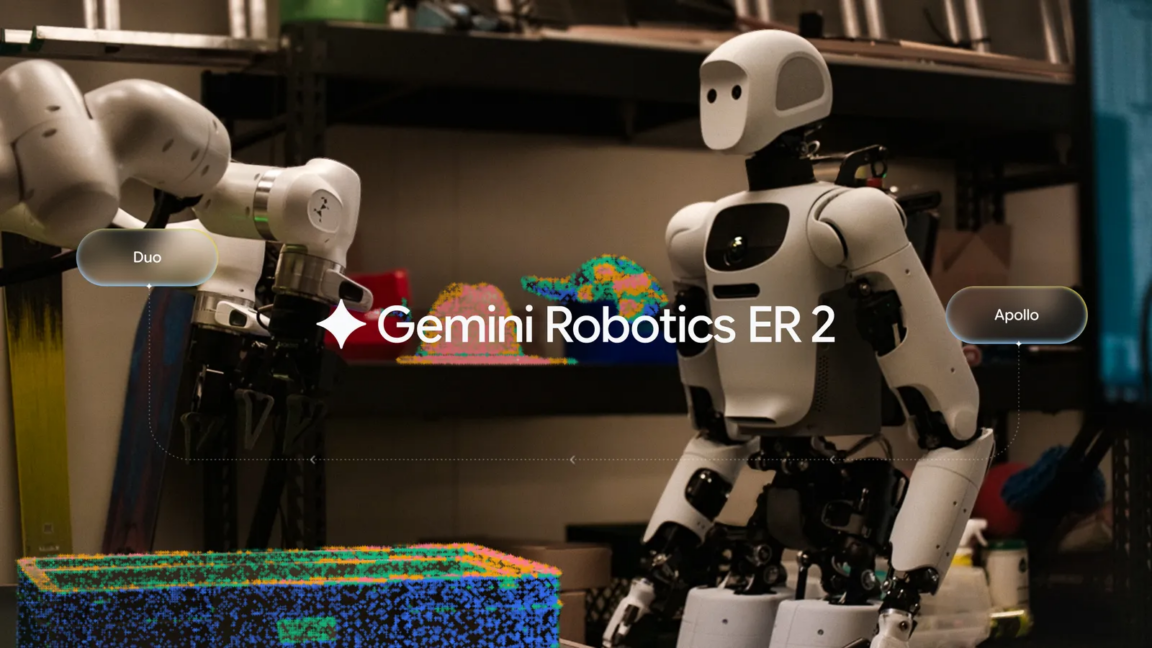
- GoogleはGemini Robotics 2を発表し、3つのモデルで構成されるが現時点で公開されているのは1つのみ。
- ロボットの器用さと安全性の向上が期待される。
Google unveiled Gemini Robotics 2, a suite of three models aimed at improving robot dexterity and safety, though only one model is currently available to the public.
本ページの本文と要約は AI による自動生成です。日本語版と英語版は言語ごとに独立して生成されるため、表現や詳しさが異なる場合があります。正確性は元記事 (arstechnica.com) をご確認ください。The body and summaries are AI-generated independently for each language, so wording and detail may differ. Verify accuracy at the original source (arstechnica.com).
要約と収集メタデータに基づく AI 解説。元記事全文の転載・翻訳ではありません。AI explainer based on the summaries and collected metadata, not a copy or translation of the full source article.
Googleは2026年7月30日、ロボット向けのAIモデル群「Gemini Robotics 2.0」を発表した。同社のAIモデル「Gemini」の技術を土台に、ロボットの器用さ(dexterity)と安全性を高めることを狙う取り組みで、3つのモデルで構成される一方、現時点で一般に公開されているのはそのうちの1つのみだとされる。
Gemini Roboticsは、視覚・言語・行動を一体的に扱う、いわゆるロボット向け基盤モデルの系譜に連なるものと位置づけられている。カメラなどから得た周囲の情報とテキストによる指示を組み合わせ、物体をつかむ、動かすといった物理的な動作へと変換することを目指す。今回の更新では、細かな手先の操作を要する作業への対応力や、動作中の安全確保といった実用面が重視されていると見られる。
発表によれば、モデル群は3つで構成されるが、公開されているのはその一部にとどまる。残るモデルの提供時期や条件について、現段階で明らかにされている情報は限られている。段階的に展開する構成は、安全性の検証や利用範囲の管理を意識したものである可能性がある。
ロボットと生成AIを結び付ける動きは近年活発化しており、複数の企業や研究機関が、多様なタスクをこなす汎用的な動作を学習させる基盤モデルの開発を進めている。人型ロボットや産業用アームを対象に、自然言語による指示や複雑な作業の自動化を狙う例も少なくない。GoogleがGeminiブランドの下でロボティクス向けのモデルを継続的に手がけていることは、同分野への注力を示すものといえる。
もっとも、実環境でロボットが安全かつ確実に動作するには、器用さの向上に加え、予期せぬ状況への対応や誤作動の抑制など、なお課題が残るとされる。今回の「Gemini Robotics 2.0」がこれらをどの程度改善するかは、開発者による実際の利用や、第三者からの評価を通じて明らかになっていくとみられる。公開範囲が広がれば、研究や産業応用の現場でどのように受け止められるかも注目される。
Google has introduced Gemini Robotics 2.0, the newest generation of its artificial intelligence system for controlling physical robots, with the company positioning improved dexterity and safety as the central advances. The release matters because it pushes Google's Gemini model family beyond software tasks such as text and image generation and into the physical world, an area where major AI developers are increasingly competing to build what are often called foundation models for robotics.
According to the announcement, Gemini Robotics 2 is made up of three separate models, but only one of them is currently available to the public. Google has not opened access to all three at launch, which suggests a staged rollout in which the remaining models may be reserved for select partners, additional testing, or a later general release. The company frames the suite as a step toward robots that can perform finer manipulation tasks and operate more safely around people and objects, though the practical extent of those improvements will likely become clearer only as developers put the released model to work.
The emphasis on dexterity is significant because fine motor control has long been one of the hardest problems in robotics. Tasks that people find trivial, such as folding fabric, threading a small part, or grasping an unfamiliar object without crushing it, require precise, adaptive responses to touch and shape. Framing dexterity as a headline feature indicates that Google is targeting these manipulation challenges rather than only navigation or simple pick-and-place operations. The parallel focus on safety appears aimed at the reality that robots increasingly share space with humans, where unpredictable movements or misjudged force can cause harm.
For context, Gemini is Google DeepMind's flagship multimodal model line, built to process text, images, audio, and other inputs together. Applying it to robotics extends that multimodal capability into an approach commonly described as vision-language-action, in which a model interprets what it sees, understands instructions phrased in natural language, and translates them into physical movement. Google's earlier robotics work established the groundwork for this direction, including systems designed for embodied reasoning, the ability to understand a scene and plan actions within it, as well as efforts to run models efficiently enough to operate on the robot itself rather than relying entirely on the cloud. Gemini Robotics 2.0 appears to continue that trajectory, although Google has not detailed how the three new models divide these roles.
The move also sits within a broader industry push toward general-purpose robotics AI. Companies such as Nvidia, which has promoted its GR00T platform for humanoid robots, along with startups like Figure and Physical Intelligence, and hardware efforts including Tesla's Optimus, are all pursuing the idea that a single, flexible AI model could power many different robot bodies and tasks. The central bet across these efforts is that the same scaling and generalization that improved language models can be applied to physical action, reducing the need to hand-program robots for each new task. Google's decision to iterate on a numbered version signals that it intends to treat robotics as an ongoing product line rather than a one-off research demonstration.
Several important details remain unclear from the initial announcement. It is not specified which of the three models is the publicly available one, what hardware it is intended to run on, or the terms under which developers can access it. The safety claims, in particular, are difficult to evaluate without independent testing, since robustness in controlled demonstrations does not always translate to reliable behavior in unstructured, real-world environments. Readers should therefore treat performance descriptions as the company's own characterizations until third-party evaluations emerge.
Even so, the release underscores how quickly large AI providers are extending their models from screens into machines. If Gemini Robotics 2.0 delivers meaningful gains in manipulation and safe operation, it could lower the barrier for building capable robots, but the staggered availability of its three models suggests Google is rolling out those capabilities cautiously rather than all at once.
ポコとTECHガイドPoko & TECH Guide
ポコと当サイトのTECHガイドが、記事の要約と収集した情報から読みどころを語るAI生成の対話です。Poko and TECH Dashboard's own TECH Guide discuss the article's highlights in an AI-generated conversation based on its summary and collected source details.
- ポコPoko3つのモデルで構成されるのに、今使えるのは1つだけなの? それってどういうこと?It has three models, but only one is available right now? What does that mean?
- TECHガイドTECH Guide記事によれば、Gemini Robotics 2は3モデルのまとまりじゃが、現時点で一般公開されているのは1つだけじゃよ。According to the article, Gemini Robotics 2 is a three-model suite, but only one model is publicly available right now.
- ポコPokoその3モデルで、何がうれしくなるの? 「器用さ」と「安全性」ってロボットではどういう意味?What’s the benefit of those three models? What do “dexterity” and “safety” mean for robots?
- TECHガイドTECH Guide簡単に言うと、器用さは動作や物の扱いの上手さ、安全性はより安全に動くことじゃな。記事では、その向上が期待されておる。Simply put, dexterity means moving and handling things skillfully, while safety means operating more safely. The article says the suite is expected to improve both.
- ポコPokoなるほど、ロボットをもっと上手に、安全に動かすための3モデルで、今は1つだけ公開中なんだね。Got it: it’s a three-model suite meant to help robots act more skillfully and safely, with only one model public for now.
- TECHガイドTECH Guideその理解でよいぞ。残る2モデルが公開されるかと、器用さや安全性が実際にどこまで向上するかが見どころじゃな。Exactly. The key things to watch are whether the other two models become public and how much dexterity and safety actually improve.