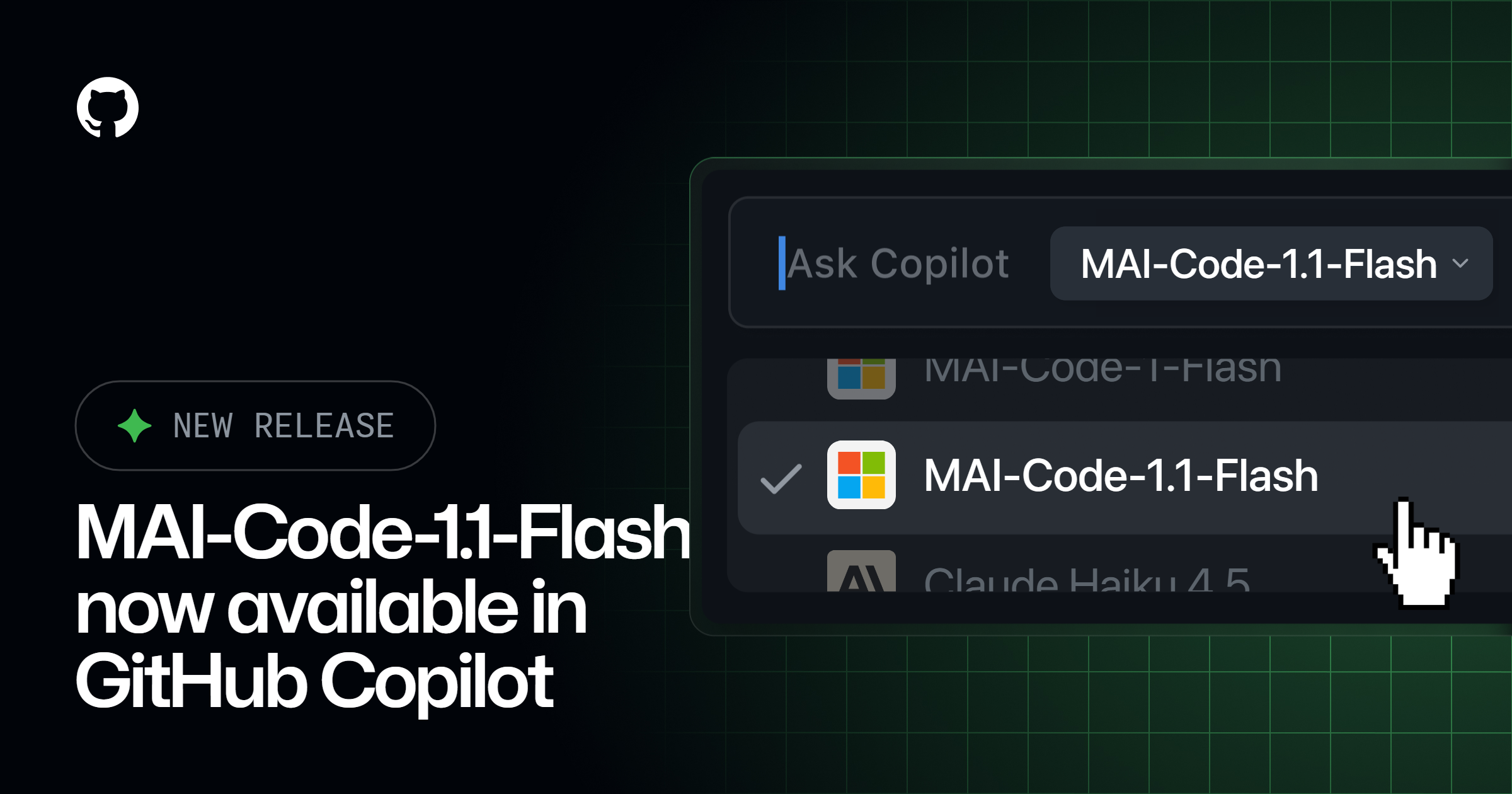
MAI-Code-1.1-Flash が GitHub Copilot で利用可能にMAI-Code-1.1-Flash available in GitHub Copilot
匿名の公開いいねです。記事の保存・お気に入りではなく、Featured、Top 3、重要度、掲載順位には影響しません。仕組みとプライバシーAnonymous public likes are reactions, not saved articles or bookmarks. They do not affect Featured, Top 3, importance, or listing order.How it works and privacy
- Microsoftの小型コーディングモデル「MAI-Code-1.1-Flash」がGitHub Copilotに展開開始。
- 前バージョンからネイティブ画像認識サポートとコーディング品質の向上が加わった。
Microsoft's MAI-Code-1.1-Flash is rolling out in GitHub Copilot, bringing native vision support for image understanding and overall coding quality improvements over its predecessor MAI-Code-1-Flash.
要約と収集メタデータをもとに生成した AI 解説本文です。元記事全文の転載・翻訳ではありません。This AI explainer is generated from the summaries and collected metadata, not from a reproduction or translation of the full source article.
MicrosoftがGitHub Copilot向けに、小型のコーディングモデル「MAI-Code-1.1-Flash」の展開を開始した。前世代の「MAI-Code-1-Flash」を土台に、画像を理解するネイティブなビジョン機能と、コーディング品質全般の改善を加えた点が特徴だ。
小型モデル(small-tier)とは、大規模モデルに比べてパラメータ規模を抑え、応答速度やコスト効率を重視した位置づけのモデルを指す。「Flash」という名称からも、軽量・高速な処理を志向したモデルと見られる。コード補完やチャットでの提案など、開発中の反復的なやり取りでは応答の速さが体験を左右しやすく、こうした小型モデルはインタラクティブな用途との相性がよいとされる。
今回のアップデートで注目されるのは、ネイティブのビジョン(画像認識)サポートだ。これにより、スクリーンショットやUIのモックアップ、図表といった画像を入力として扱い、内容を踏まえた提案を得られる可能性がある。画面のエラー表示やデザイン案を共有しながら実装を進めるような場面で、テキストだけでは伝えにくい情報を補える点は実務的な意義が大きいと考えられる。
Microsoftの小型コーディングモデル「MAI-Code-1.1-Flash」がGitHub Copilotに展開開始。
背景として、GitHub Copilotは近年、単一のモデルに依存せず複数のモデルから選べる方向へと機能を広げてきた。他社製を含む複数のモデルが選択肢として提供されるなか、Microsoft自身が開発する「MAI」系モデルの投入は、用途や好みに応じた選択肢をさらに増やす動きと位置づけられる。
現時点では段階的な展開(rolling out)の途上とされ、すべての利用者や環境で即座に使えるとは限らない。実際の利用可否や対象範囲については、公式のドキュメントや設定画面での確認が求められる。生成AIを組み込んだ開発支援ツールの競争が続くなか、コード品質の向上と画像理解の両立をうたう今回の更新が、日々の開発ワークフローにどの程度寄与するかが注目される。
Microsoft has begun rolling out MAI-Code-1.1-Flash, its latest small-tier coding model, to GitHub Copilot. The update matters because it extends Copilot's growing roster of selectable models with a lightweight option that now understands images natively, a capability that has historically been reserved for larger, more expensive models. For developers who rely on fast, low-latency assistance, the addition suggests Microsoft is trying to close the gap between compact models and their heavier counterparts without sacrificing responsiveness.
According to the GitHub changelog, MAI-Code-1.1-Flash builds directly on the earlier MAI-Code-1-Flash. The headline change is native vision support for image understanding, meaning the model can process visual inputs rather than text alone. In a coding context, that typically covers scenarios such as interpreting screenshots of error messages, reading UI mockups, examining diagrams, or reasoning about charts and design references pasted into a prompt. Microsoft also states that the release delivers improvements across coding quality, positioning it as a general upgrade over its predecessor rather than a narrowly scoped patch.
The "Flash" designation and the "small-tier" label are the key framing here. Small models are generally designed to prioritize speed and cost efficiency over raw capability, making them well suited to high-frequency tasks like autocomplete-style suggestions, quick edits, and iterative back-and-forth where latency is felt most acutely. By adding vision to a model in this class, Microsoft appears to be targeting workflows where developers frequently share visual context but do not necessarily need the deliberation of a larger reasoning model. The tradeoffs typical of this tier still apply, and the changelog does not claim parity with the largest models on complex, multi-step problems.
This release fits into the broader shift GitHub Copilot has made toward a multi-model architecture. Rather than being tied to a single underlying model, Copilot now lets users pick from a menu that has included offerings from multiple providers, and Microsoft's own MAI family represents its in-house contribution to that lineup. The MAI branding refers to Microsoft AI's internal model development effort, which the company has been expanding as it seeks to complement, and in some cases reduce reliance on, models sourced from partners. A steady cadence of incremental version bumps, such as moving from 1 to 1.1, is consistent with how these model families are iterated and shipped through the changelog.
Availability is described as a rollout, which usually means the model becomes accessible progressively rather than to every user simultaneously. Access to specific models in Copilot can also depend on the plan a customer is on, the client being used, and administrative settings for organizations, so the exact timing and surface where MAI-Code-1.1-Flash appears is likely to vary. Developers who want to try it would generally select it from Copilot's model picker where supported, though the changelog excerpt does not enumerate every entry point or any regional and pricing specifics.
For context, native vision has become an increasingly common expectation across AI coding tools, and its usefulness in software work is straightforward. Being able to hand a model a picture of a broken layout, a stack trace captured as an image, or a whiteboard sketch removes friction from tasks that previously required manual transcription. Competing assistants and foundation models from other vendors have offered multimodal understanding for some time, so bringing it to a small, fast model is less about introducing a novel feature and more about making that capability cheaper and quicker to invoke inside everyday development loops.
It is worth treating the stated improvements with appropriate caution. The changelog frames the gains in general terms, and Microsoft has not, in this excerpt, published benchmark figures, supported languages, image-size limits, or detailed guidance on where the vision feature performs best. As with any model update, real-world quality tends to depend heavily on the specific task, the prompt, and the surrounding tooling, so the practical benefit will become clearer as developers exercise it across diverse codebases.
In sum, MAI-Code-1.1-Flash is an incremental but meaningful step for Microsoft's small-model strategy within GitHub Copilot, pairing multimodal input with claimed coding-quality gains in a tier built for speed. The move reinforces both the ongoing expansion of the MAI lineup and Copilot's model-choice approach, and its ultimate value will hinge on how it performs against alternatives already available in the picker.
本ページの本文と要約は AI による自動生成です。日本語版と英語版は言語ごとに独立して生成されるため、表現や詳しさが異なる場合があります。正確性は元記事 (github.blog) をご確認ください。The body and summaries are AI-generated independently for each language, so wording and detail may differ. Verify accuracy at the original source (github.blog).