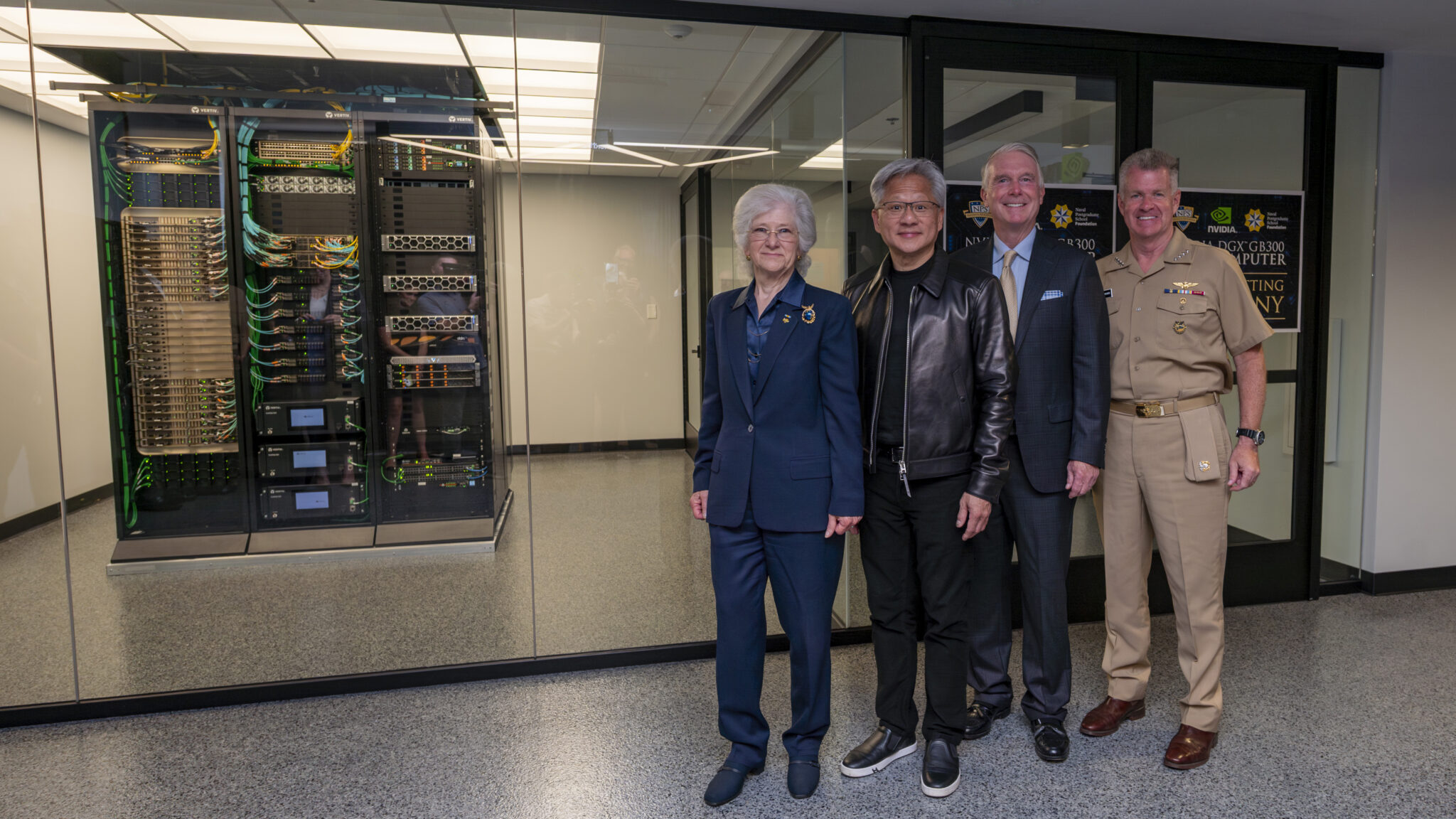
海軍大学院にNVIDIA AIスーパーコンピューターが稼働開始NVIDIA AI Supercomputer Comes Online at Naval Postgraduate School
匿名の公開いいねです。記事の保存・お気に入りではなく、Featured、Top 3、重要度、掲載順位には影響しません。仕組みとプライバシーAnonymous public likes are reactions, not saved articles or bookmarks. They do not affect Featured, Top 3, importance, or listing order.How it works and privacy
米海軍大学院がNVIDIA DGXベースのAIスーパーコンピューターを導入・稼働させ、軍事研究や教育におけるAI活用能力を大幅に強化した。
The Naval Postgraduate School has brought an NVIDIA DGX-based AI supercomputer online, significantly boosting its capacity for AI-driven military research and education.
本ページの本文と要約は AI による自動生成です。日本語版と英語版は言語ごとに独立して生成されるため、表現や詳しさが異なる場合があります。正確性は元記事 (blogs.nvidia.com) をご確認ください。The body and summaries are AI-generated independently for each language, so wording and detail may differ. Verify accuracy at the original source (blogs.nvidia.com).
要約と収集メタデータに基づく AI 解説。元記事全文の転載・翻訳ではありません。AI explainer based on the summaries and collected metadata, not a copy or translation of the full source article.
米海軍大学院(Naval Postgraduate School、NPS)が、NVIDIAのDGXシステムを基盤とするAIスーパーコンピューターを導入し、稼働を開始した。国防分野の教育・研究機関がこうした大規模なAI計算基盤を整える動きは、軍事研究におけるAI活用の裾野が広がりつつあることを象徴している。
NPSはカリフォルニア州モントレーに拠点を置く海軍の大学院で、士官らが科学・工学・安全保障などの高度な学位を取得する場として知られる。今回導入されたシステムは、多数のGPUを搭載するNVIDIAのDGXプラットフォームをベースにしており、大規模言語モデル(LLM)の学習・推論やシミュレーション、データ解析といった計算負荷の高い処理を学内で完結できるようになると見られる。
DGXは、NVIDIAが提供するAI開発向けの統合型サーバー製品で、複数のGPUを高速インターコネクトで結び、深層学習の訓練を効率化する設計が特徴だ。近年はHopperアーキテクチャのH100や後継のBlackwell世代など、生成AIブームを背景に需要が急増しており、研究機関や企業のほか、政府・防衛関連の組織による調達も目立つようになっている。
軍事・安全保障の文脈では、AIは無人システムの自律制御、画像・信号の解析、後方支援の最適化、サイバー防御など幅広い応用が検討されている。ただし、こうした技術は倫理面や運用上のリスクをめぐる議論も伴うため、教育機関が計算基盤を持つ意義は、実運用そのものよりも人材育成や基礎研究の側面が大きいと考えられる。学内に高性能な環境を置くことで、機密性の高いデータを外部クラウドに預けずに扱いやすくなる利点もある可能性がある。
背景として、米国防総省は近年AI導入を加速させており、専門組織を通じた指針づくりや実証を進めている。NVIDIA以外にもAMDやIntel、クラウド各社がAI計算資源の供給を競っており、今回のNPSの取り組みは、防衛領域におけるAIインフラ整備の一例として位置づけられる。今後、教育・研究の成果がどのように実装へ結び付いていくかが注目される。
The Naval Postgraduate School, the U.S. Navy's graduate research and education institution in Monterey, California, has brought an NVIDIA DGX-based artificial intelligence supercomputer online, according to a post on the NVIDIA blog. The deployment matters because it places substantial AI compute directly in the hands of military students, faculty, and researchers, signaling how defense-oriented academic institutions are moving to build in-house capacity for training and running modern machine learning models rather than relying solely on external or commercial cloud resources.
At the center of the installation is NVIDIA's DGX platform, a line of integrated systems purpose-built for AI and high-performance computing workloads. DGX servers combine multiple GPUs with high-speed interconnects, large pools of memory, and a preconfigured software stack, allowing organizations to stand up capable AI infrastructure without assembling components piece by piece. The systems are designed to handle demanding tasks such as training large neural networks, fine-tuning models on domain-specific data, and running inference at scale. For an institution like the Naval Postgraduate School, this kind of turnkey hardware can shorten the path from procurement to productive research.
The stated goal is to strengthen AI-driven research and education across the school. In practice, that likely encompasses a broad range of activities, from coursework that teaches students how to build and evaluate models, to thesis projects and faculty research that apply AI to problems relevant to naval and joint operations. Areas that commonly draw interest in defense-related settings include data analysis, autonomous systems, sensor fusion, logistics optimization, cybersecurity, and modeling and simulation. Having dedicated on-premises compute can also be important in defense contexts where data sensitivity, security requirements, and control over the computing environment are significant considerations.
The move fits within a wider pattern of AI adoption across the U.S. Department of Defense and allied militaries. Over recent years, the department has established organizations such as the Chief Digital and Artificial Intelligence Office to coordinate AI efforts, and it has pursued initiatives aimed at accelerating the responsible use of AI and autonomy. Educational institutions tied to the armed services play a role in this ecosystem by developing the workforce and the foundational research that underpin later operational capabilities. An AI supercomputer at a graduate school is therefore aimed as much at building human expertise as at producing specific technical outputs.
NVIDIA's involvement reflects the company's central position in the AI hardware market. Its GPUs and the surrounding CUDA software ecosystem have become widely used across research, industry, and government, and the DGX line represents the company's effort to package that technology into complete systems. NVIDIA also offers related infrastructure such as its networking technologies and the DGX Cloud service, and it supports higher-level frameworks for building AI applications. The choice of a DGX-based system suggests the school is aligning with tooling that is common in the broader AI community, which can ease collaboration and the recruitment of talent already familiar with the environment.
For readers less familiar with the underlying concepts, an AI supercomputer differs from a traditional high-performance computing cluster mainly in its emphasis on GPU acceleration and the parallel mathematics that modern deep learning depends on. Where classical HPC has long served scientific simulation in fields like fluid dynamics or weather modeling, AI-focused systems are optimized for the matrix operations at the heart of neural networks. Many contemporary facilities blend both roles, supporting simulation alongside machine learning, and it is reasonable to expect a research-oriented institution to use its resources across a mix of workloads.
Some details of the deployment, including the exact number and generation of GPUs, total performance figures, and the specific projects that will run on the system, were not fully specified in the available summary and would need confirmation from primary sources. What is clear is the direction of travel: defense education is investing in dedicated AI infrastructure, and vendors like NVIDIA are supplying the integrated systems to enable it. As models grow larger and more capable, access to sufficient compute has become a practical prerequisite for meaningful research, and installations of this kind appear intended to keep military-affiliated institutions competitive in a rapidly evolving field. The longer-term impact will depend on how effectively the school translates raw computing capacity into trained personnel and applicable findings.
ポコとTECHガイドPoko & TECH Guide
ポコと当サイトのTECHガイドが、記事の要約と収集した情報から読みどころを語るAI生成の対話です。Poko and TECH Dashboard's own TECH Guide discuss the article's highlights in an AI-generated conversation based on its summary and collected source details.
- ポコPokoNVIDIA DGXベースのAIスーパーコンピューターが「稼働」って、つまりどういうこと?An NVIDIA DGX-based AI supercomputer is now “online”—what does that actually mean?
- TECHガイドTECH Guide簡単に言うと、導入したシステムが使える状態になったということじゃな。記事によれば、学生や研究者、教員向けじゃよ。Simply put, the installed system is now ready to use. According to the article, it’s available to students, researchers, and faculty.
- ポコPokoへえ、すごい!それって何がうれしいの?軍事研究だけじゃなく、教育にも役立つの?Wow! So what’s the benefit? Is it meant to help education as well as military research?
- TECHガイドTECH Guide記事では、AIを使った軍事研究と教育の能力が大幅に強化されたとしておる。具体的な成果は、これからじゃな。The article says it significantly expands the school’s capacity for AI-driven military research and education. Specific results, though, are still to come.
- ポコPokoつまり、学生や研究者、教員がAIを研究と教育に活用するための強力な基盤が動き始めたんだね。So a powerful foundation for students, researchers, and faculty to use AI in research and education is now up and running.
- TECHガイドTECH Guideその理解でよいぞ。今後は、このシステムが実際の研究や教育でどう活用されるかが見どころじゃな。That’s right. The key thing to watch is how the system is actually used in research and education from here.