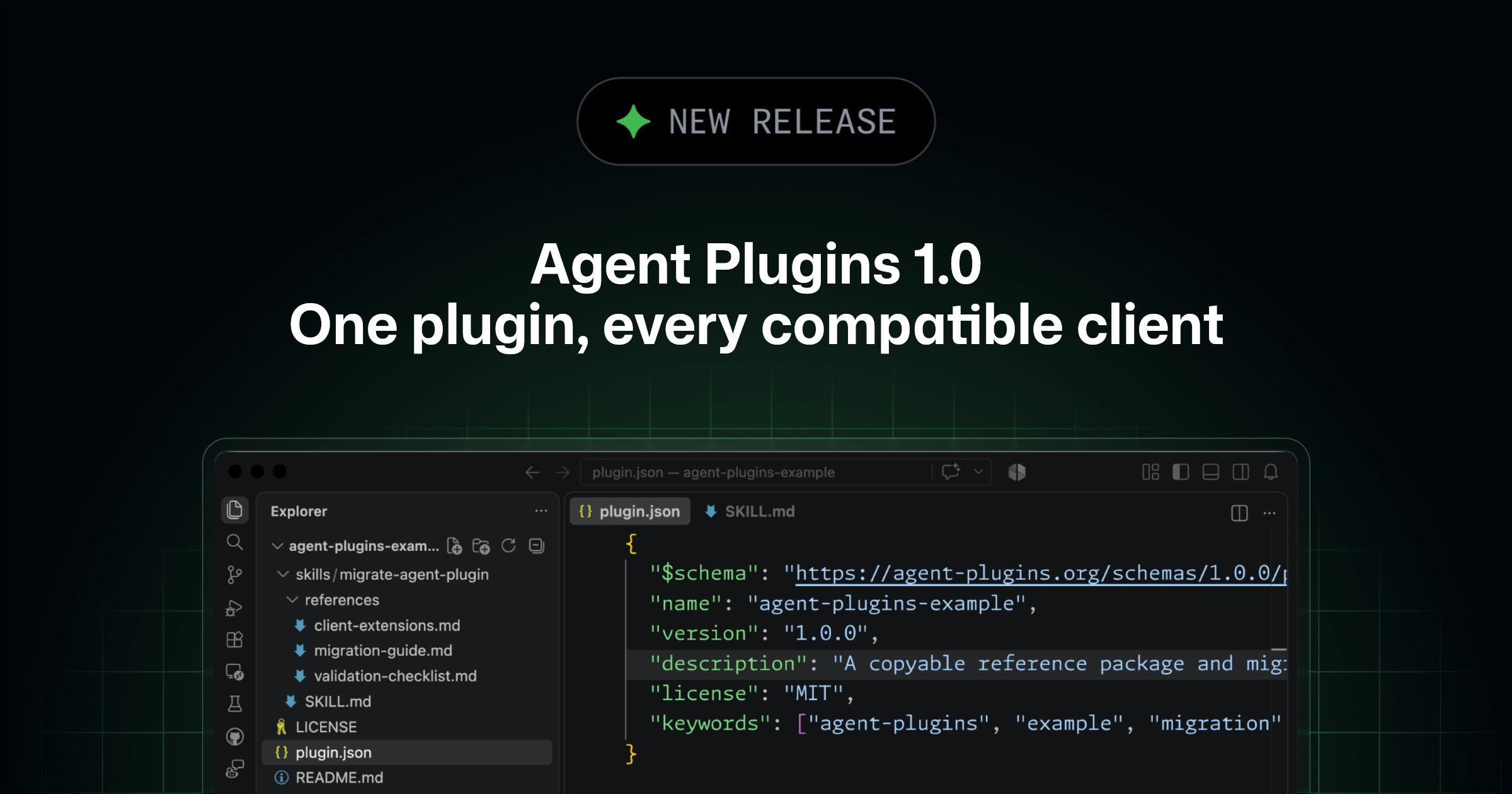
VS Code・Copilot CLI・CopilotアプリでAgent Plugins 1.0が利用可能にAgent Plugins 1.0 in VS Code, Copilot CLI, and the Copilot app
匿名の公開いいねです。記事の保存・お気に入りではなく、Featured、Top 3、重要度、掲載順位には影響しません。仕組みとプライバシーAnonymous public likes are reactions, not saved articles or bookmarks. They do not affect Featured, Top 3, importance, or listing order.How it works and privacy
- AWS・Anysphere・Microsoft・OpenAI・Vercelと共同策定したAgent Plugins 1.0により、一度作ったプラグインを対応する複数のエージェントクライアントで横断的に再利用できる。
- 開発者の実装コスト削減と相互運用性の向上に貢献する。
Agent Plugins 1.0, co-developed with AWS, Anysphere, Microsoft, OpenAI, and Vercel, lets developers build a single plugin and deploy it across every compatible agent client including VS Code, Copilot CLI, and the Copilot app, eliminating duplicate integration work.
本ページの本文と要約は AI による自動生成です。日本語版と英語版は言語ごとに独立して生成されるため、表現や詳しさが異なる場合があります。正確性は元記事 (github.blog) をご確認ください。The body and summaries are AI-generated independently for each language, so wording and detail may differ. Verify accuracy at the original source (github.blog).
要約と収集メタデータに基づく AI 解説。元記事全文の転載・翻訳ではありません。AI explainer based on the summaries and collected metadata, not a copy or translation of the full source article.
GitHubは、VS Code・Copilot CLI・Copilotアプリで利用できる「Agent Plugins 1.0」を公開した。一度作成したプラグインを、対応する複数のエージェントクライアント間で共通して使えるようにする仕組みで、AIエージェントを取り巻くツール群の相互運用性(インターオペラビリティ)を高める取り組みとして注目される。
同社の変更履歴によると、Agent Plugins 1.0は8月6日に公開された。開発にはGitHubのほか、AWS、Anysphere、Microsoft、OpenAI、Vercelが参加しており、複数のベンダーが足並みをそろえて共通仕様の整備に関わった点が特徴だ。これにより、開発者はプラグインを一度作れば、対応するエージェント環境をまたいで展開できるとされている。
背景には、コード補助やタスク実行を担うAIエージェントが急速に広がる一方で、クライアントごとに拡張の作法が異なり、同じ機能を各環境向けに作り直す負担が生じやすいという課題があると見られる。共通のプラグイン規格を用意すれば、開発の重複を減らし、エコシステム全体で機能を再利用しやすくなる可能性がある。
今回の座組みには、クラウド事業者やモデル提供者、フロントエンド基盤を手がける企業など、レイヤーの異なる主要プレイヤーが名を連ねている。Anysphereはコードエディタ「Cursor」を開発する企業として知られており、こうした多様な参加者が同じ規格を支持することは、特定の製品にとどまらない広がりを示唆していると言えそうだ。
もっとも、実際にどこまで幅広い互換性が確保されるかは、各クライアントの対応状況や今後の仕様の成熟度に左右される面がある。GitHubはCopilotを軸に、VS CodeやCopilot CLIといった自社の開発者向けツール群への統合を進めており、Agent Plugins 1.0はその相互運用性を一歩前進させる位置づけと受け止められる。プラグイン開発を検討する場合は、対応するクライアントや必要な前提条件について、公式の案内を確認するのが確実だろう。
GitHub has released Agent Plugins 1.0, a specification that lets developers build a single plugin and run it across multiple AI agent clients, including Visual Studio Code, the Copilot CLI, and the standalone Copilot app. The release matters because it points toward greater interoperability in the fast-growing and increasingly fragmented market for AI coding agents, where extensions and integrations have often had to be rebuilt separately for each tool.
According to GitHub's changelog, Agent Plugins 1.0 was published on August 6 and was developed in collaboration with AWS, Anysphere, Microsoft, OpenAI, and Vercel. The core promise is summarized in a single line from the announcement: "You can now build a plugin once and use it across all compatible agent clients." In practical terms, this suggests that a plugin author would no longer need to maintain distinct versions for every environment their users happen to work in, provided those environments adopt the shared specification.
The list of collaborators is notable because it spans several companies that are usually treated as competitors. Anysphere is the maker of the Cursor editor, Vercel produces the v0 generation tooling and hosting platform, OpenAI supplies widely used foundation models and its own developer-facing agents, and Microsoft and AWS operate two of the largest cloud platforms as well as their own developer tooling. A specification backed by this range of vendors appears intended to establish common ground rather than to favor a single ecosystem, though the practical breadth of support will depend on how many clients ultimately implement it.
Agent Plugins fit into a broader industry effort to standardize how AI agents connect to external tools, data, and actions. The most prominent adjacent example is the Model Context Protocol (MCP), an open standard introduced by Anthropic that has since been adopted across many editors and agent frameworks as a common way to expose tools and context to language models. Efforts like MCP and Agent Plugins address a recurring problem: as more applications embed autonomous or semi-autonomous agents, developers face mounting duplication when they must wire the same capability into each product's proprietary extension format. A shared plugin model is likely aimed at reducing that overhead and improving portability.
For context, the three clients named in the release represent different surfaces where Copilot already operates. Visual Studio Code is Microsoft's widely used editor and the primary home for GitHub Copilot's in-editor features, including its agent mode. The Copilot CLI brings agent capabilities to the command line, where developers can issue instructions and run tasks in a terminal workflow. The Copilot app refers to the standalone experience outside the editor. Supporting a single plugin across all three would let a capability written once surface consistently whether a developer is editing code, working in a shell, or using the dedicated application.
The announcement is framed as a versioned 1.0 release, which typically signals that the maintainers consider the specification stable enough for production use and are committing to a baseline that downstream implementers can target. It does not, on its own, guarantee that every future agent client will comply, and the excerpt does not detail the full technical scope of what a plugin can do, how plugins are packaged, or the security and permission model that governs their actions. Those details would be important for developers evaluating whether to migrate existing integrations, and readers should consult GitHub's official documentation for specifics.
More broadly, the move reflects a phase of the AI tooling market in which interoperability is becoming a competitive and strategic concern in its own right. Vendors that once differentiated through closed integrations increasingly appear to see value in shared standards that lower switching costs for developers and expand the total addressable ecosystem. Whether Agent Plugins 1.0 becomes a durable, widely adopted standard or one of several competing approaches will likely depend on the pace of client adoption, the quality of the tooling GitHub and its partners provide, and how it coexists with existing efforts such as MCP. For now, the release gives plugin authors a concrete, multi-vendor target to build against.
ポコとTECHガイドPoko & TECH Guide
ポコと当サイトのTECHガイドが、記事の要約と収集した情報から読みどころを語るAI生成の対話です。Poko and TECH Dashboard's own TECH Guide discuss the article's highlights in an AI-generated conversation based on its summary and collected source details.
- ポコPokoAgent Plugins 1.0って何? 一度作れば、どこでも使えるってこと?What exactly is Agent Plugins 1.0? Does “build once” mean it works everywhere?
- TECHガイドTECH Guide簡単に言うと、エージェントに機能を足す共通の仕組みじゃな。記事によれば、対応する複数のクライアントで再利用できるぞ。Simply put, it’s a shared way to add capabilities to agents. According to the article, one plugin can be reused across multiple compatible clients.
- ポコPokoそれって何がうれしいの? VS Code用とCopilot CLI用を別々に作らなくていいの?Why is that useful? Does it mean developers don’t need separate versions for VS Code and Copilot CLI?
- TECHガイドTECH Guideその理解でよいぞ。記事では、VS CodeやCopilot CLI、Copilotアプリ向けの重複した実装を減らせるとしておる。That’s the idea. The article says it reduces duplicate integration work across VS Code, Copilot CLI, and the Copilot app.
- ポコPokoなるほど! 共通ルールで、プラグイン作りの手間を減らしつつ連携しやすくするんだね。Got it! A shared standard can cut plugin development work and make different agent clients easier to support.
- TECHガイドTECH Guideそうじゃな。AWSなどと共同策定した点も注目じゃが、使い回せるのはあくまで対応クライアント間、という点は押さえたいのう。Exactly. It was co-developed with AWS and others, but remember: reuse applies only across compatible clients.