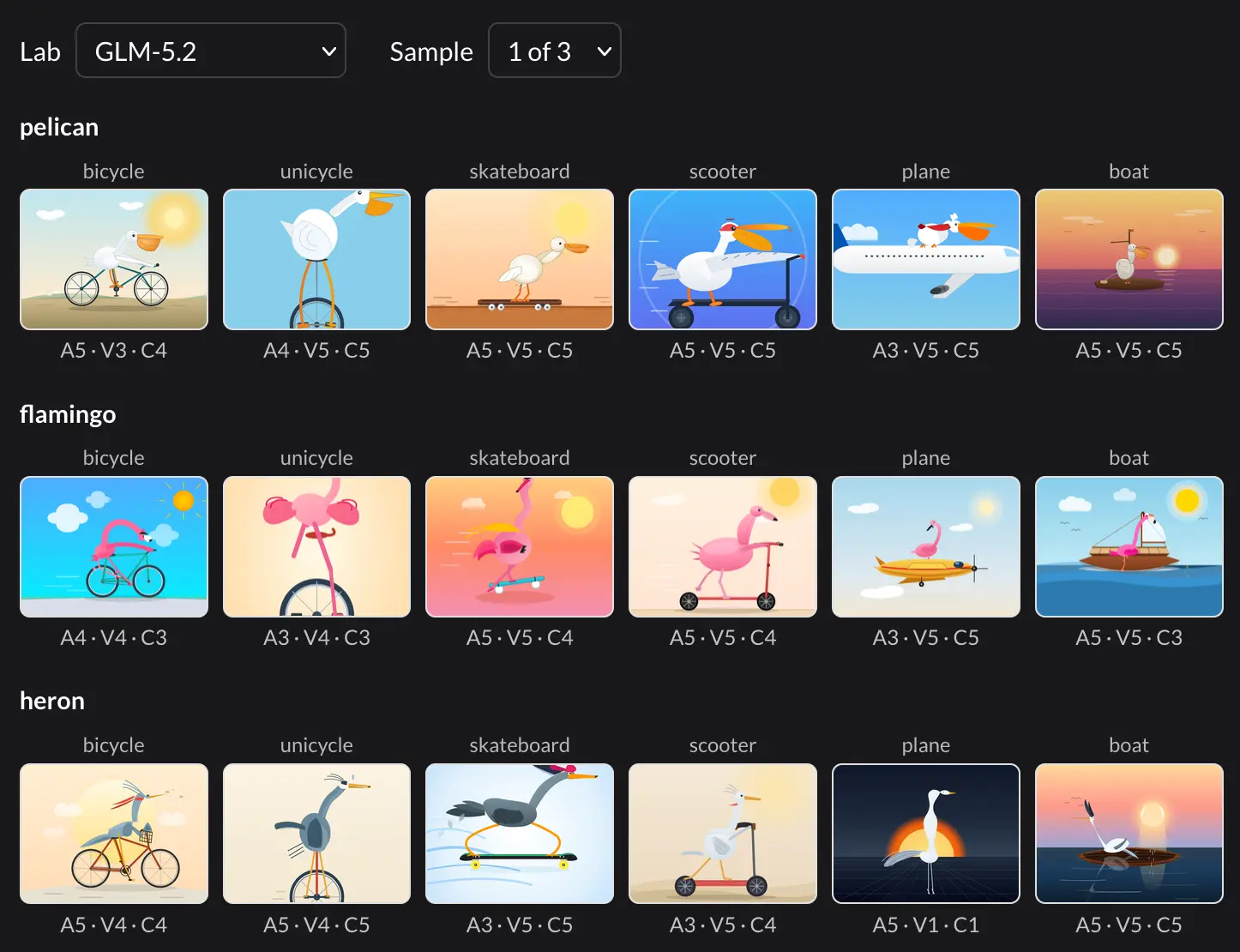
AIラボは「pelicanmaxxing」をしているのか?Are AI labs pelicanmaxxing?
匿名の公開いいねです。記事の保存・お気に入りではなく、Featured、Top 3、重要度、掲載順位には影響しません。仕組みとプライバシーAnonymous public likes are reactions, not saved articles or bookmarks. They do not affect Featured, Top 3, importance, or listing order.How it works and privacy
Simon Willison氏が、AIラボがベンチマーク向けに過剰最適化する「pelicanmaxxing」と呼ばれる現象を考察し、実用性より指標改善を優先するリスクを指摘した記事。
Simon Willison examines whether AI labs are "pelicanmaxxing" — over-optimizing for benchmarks and metrics at the expense of genuine usefulness, and what that means for the field.
本ページの本文と要約は AI による自動生成です。日本語版と英語版は言語ごとに独立して生成されるため、表現や詳しさが異なる場合があります。正確性は元記事 (simonwillison.net) をご確認ください。The body and summaries are AI-generated independently for each language, so wording and detail may differ. Verify accuracy at the original source (simonwillison.net).
要約と収集メタデータに基づく AI 解説。元記事全文の転載・翻訳ではありません。AI explainer based on the summaries and collected metadata, not a copy or translation of the full source article.
AI開発者のSimon Willison氏が、AIラボがベンチマーク向けにモデルを過剰最適化する「pelicanmaxxing(ペリカンマクシング)」と呼べる現象について考察したブログ記事を公開した。実用的な有用性よりも特定の指標改善を優先することのリスクを問う内容だ。
Willison氏は以前から、新しい大規模言語モデル(LLM)が登場するたびに「自転車に乗ったペリカンのSVG画像を生成せよ」という独自のテストを課してきた。ペリカンと自転車という描きにくい題材をコードだけでベクター画像として表現させることで、モデルの空間把握やコード生成の力を直感的に比較できる。この非公式ベンチマークはSNSなどを通じて広く知られるようになった。
「-maxxing」はインターネットスラングで、ある指標を極端に追い求める行為を指す。つまりpelicanmaxxingとは、AIラボがこのテストで良い結果を出すために、ペリカンのSVG生成を狙って訓練やチューニングを調整している可能性を揶揄する言葉だ。氏自身は、実際にそうした最適化が行われている確証はないとしつつも、テストが有名になったことで本来の目的が損なわれかねないと注意を促している。
背景には、「測定が目標になると、その測定は良い指標ではなくなる」というグッドハートの法則がある。LLMの分野では、MMLUやHumanEvalといった標準ベンチマークで高スコアを出すことが競争の焦点となり、テスト問題がそのまま訓練データに混入する「ベンチマーク汚染(コンタミネーション)」や、特定の問題形式への過剰適応がかねて指摘されてきた。スコアは上がっても、実際のタスクでの使い勝手が伴わないという乖離が起きうる。
こうした懸念を受けて、業界では汚染されにくい評価手法の模索が進んでいる。非公開のプライベート評価セット、実際の利用ログに基づく評価、人間の相対評価を集めるChatbot Arenaのような仕組みなどが代表例だ。Willison氏の指摘は、単一の指標を過信せず、多様で予測困難な評価を組み合わせる重要性を改めて示すものと言える。
pelicanmaxxingという言葉自体は半ば冗談めいているが、その問いかけは本質的だ。ベンチマーク偏重が続けば、利用者が本当に必要とする能力とモデルの見かけの性能とのギャップが広がる可能性がある。評価のあり方そのものが、今後のAI開発の質を左右する論点になりつつある。
Simon Willison, the developer and prolific AI commentator, has raised a pointed question about the direction of large language model development: are AI labs "pelicanmaxxing"? The term combines his own informal benchmark — asking a model to generate an SVG image of a pelican riding a bicycle — with the internet suffix "-maxxing," which implies obsessively optimizing for a single outcome. The underlying concern is familiar but increasingly relevant: that model builders may be tuning their systems to score well on visible tests rather than to become genuinely more capable. It matters because the public largely judges new models by exactly these headline results.
The pelican test itself has an unusual origin. Willison began asking models to produce vector graphics of a pelican on a bicycle as a lightweight, memorable way to probe several abilities at once. Generating valid SVG requires a model to reason about coordinates, shapes, and spatial relationships without seeing the rendered output, and drawing a recognizable pelican astride a bicycle — a subject unlikely to appear verbatim in training data — is genuinely hard. Over time the challenge gained a following, with results shared widely and treated as an offhand gauge of each new release.
That popularity is precisely what creates the risk Willison appears to be describing. Once a test becomes well known, labs have an incentive, whether deliberate or incidental, to ensure their models handle it well. This is a specific instance of Goodhart's Law: when a measure becomes a target, it ceases to be a good measure. If a model does unusually well on the pelican prompt because its training emphasized that exact scenario, the result no longer says much about the model's broader competence. "Pelicanmaxxing" is a tongue-in-cheek label for this failure mode, but the concern generalizes far beyond one whimsical drawing.
The same dynamic is a long-standing worry for formal benchmarks. Suites such as MMLU, GPQA, HumanEval, and SWE-bench are routinely cited in launch materials, and strong scores can shape media coverage, developer adoption, and investment narratives. Researchers have repeatedly flagged benchmark contamination, where test questions or close variants leak into training data, as well as more subtle overfitting where models are refined against the style of popular evaluations. Crowd-based comparisons like LMArena, which rank models by human preference, were partly a response to these problems, though they introduce their own biases toward answers that simply feel appealing.
Willison's framing is useful because it makes an abstract statistical hazard concrete and slightly absurd. A pelican on a bicycle is obviously not something users need, so if labs were quietly optimizing for it, the gap between benchmark performance and practical value would be laid bare. The broader point is that any widely watched metric can drift from measuring capability to measuring the ability to satisfy that metric. This is especially likely in a competitive market where a handful of leading labs release models on overlapping timelines and compete for the same attention.
There are reasons to be measured about the accusation. It is difficult to prove that any given lab is deliberately gaming a specific test, and much apparent improvement is likely genuine, driven by larger and cleaner datasets, better training techniques, and more capable base models. Optimizing for a memorable challenge is also not automatically dishonest; the danger lies in mistaking a narrow, tuned result for evidence of general progress. Willison seems to be posing a question rather than leveling a firm charge.
The practical takeaway for developers and organizations is to treat any single benchmark, including informal ones, as one signal among many. Private evaluations built from an organization's own tasks are harder to game precisely because labs cannot see them, and they map more directly onto real needs. Techniques such as holding out fresh test sets, rotating prompts, and inspecting outputs qualitatively can help distinguish real capability from surface polish. As the field continues to lean on leaderboards to communicate progress, Willison's coining of "pelicanmaxxing" is a compact reminder that the map is not the territory, and that a model's usefulness is ultimately measured by the work it actually helps people do.
ポコとTECHガイドPoko & TECH Guide
ポコと当サイトのTECHガイドが、記事の要約と収集した情報から読みどころを語るAI生成の対話です。Poko and TECH Dashboard's own TECH Guide discuss the article's highlights in an AI-generated conversation based on its summary and collected source details.
- ポコPoko「pelicanmaxxing」って何? AIラボがペリカンの自転車画像を描けるよう、わざと訓練しているってこと?What’s “pelicanmaxxing”? Does it mean AI labs are deliberately training models to draw pelicans riding bicycles?
- TECHガイドTECH Guide簡単に言うと、実用性よりベンチマークや指標に合わせて過剰に最適化することじゃな。記事は、実際にそうした訓練があるのかを考察しておる。Simply put, it means over-optimizing for benchmarks and metrics instead of real usefulness. The article examines whether labs are actually training models that way.
- ポコPokoでも、指標が良くなるなら嬉しいんじゃないの? 何が問題なの?But isn’t improving the metrics a good thing? What’s the problem?
- TECHガイドTECH Guide記事が指摘するのは、数字の改善が本当の使いやすさより優先されるリスクじゃよ。指標だけでは実用性を十分に示せないかもしれんのじゃ。The article warns that better numbers may be prioritized over genuine usefulness. A metric alone might not fully reflect how useful a model really is.
- ポコPokoなるほど。ペリカンを描けるかや点数だけでなく、実際に役立つかを見る必要があるんだね。Got it. We shouldn’t just look at pelican drawings or scores—we need to ask whether the model is actually useful.
- TECHガイドTECH Guideその通りじゃ。意図的な最適化かは断定されていないので、ベンチマーク改善と実用性の差を見極めるのが今後の注目点じゃな。Exactly. The article doesn’t conclude that this is deliberate, so the key is watching for gaps between benchmark gains and real-world usefulness.