DeepSeek V4 Flashの新モデル「DeepSeek-V4-Flash-0731」公開deepseek-ai/DeepSeek-V4-Flash-0731
匿名の公開いいねです。記事の保存・お気に入りではなく、Featured、Top 3、重要度、掲載順位には影響しません。仕組みとプライバシーAnonymous public likes are reactions, not saved articles or bookmarks. They do not affect Featured, Top 3, importance, or listing order.How it works and privacy
- DeepSeekがV4ファミリーの最新モデルを公開。
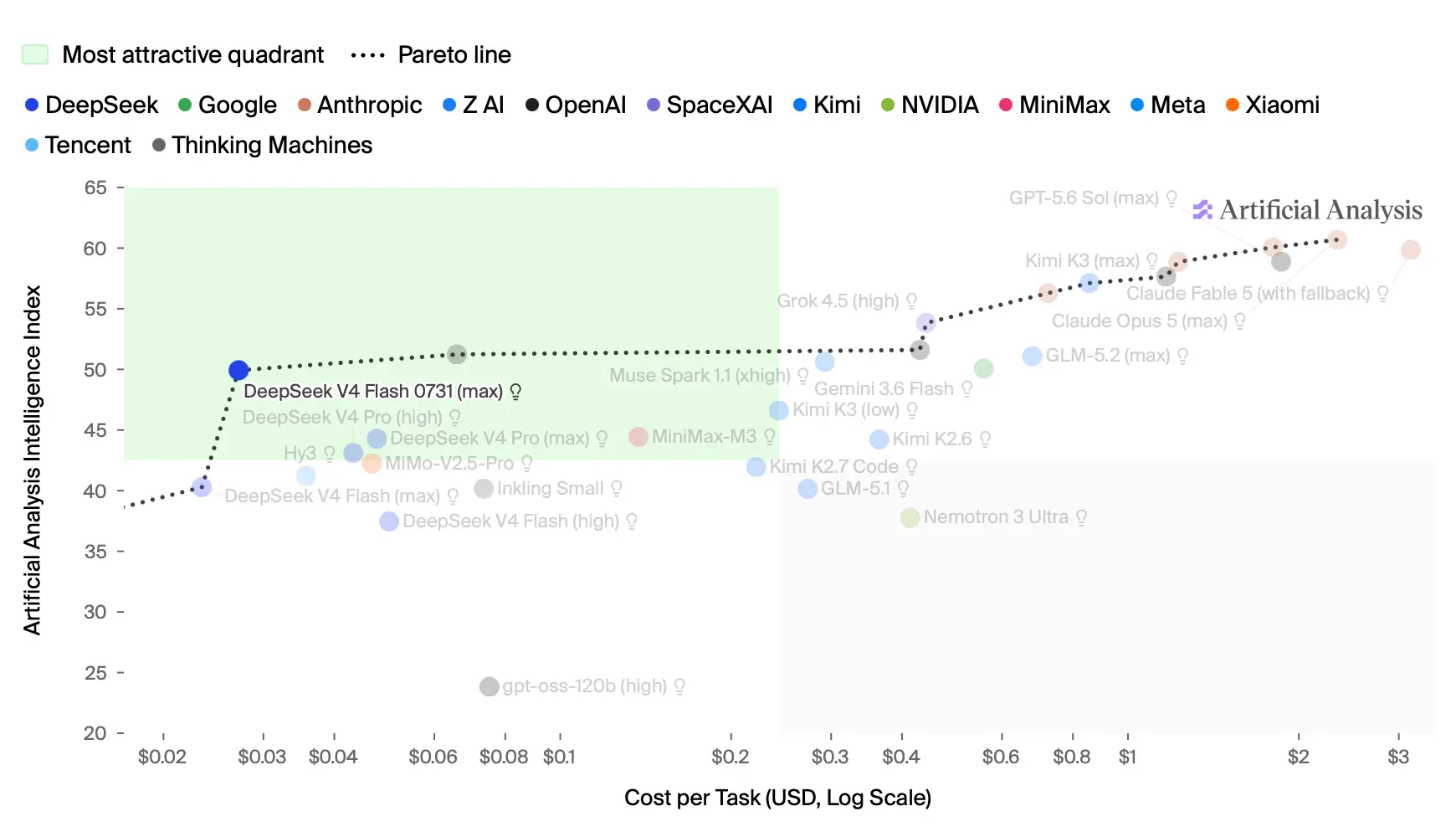
- 3040億パラメータ(167GB)ながらエージェント能力が大幅強化され、Artificial AnalysisではMiniMax M3を上回る評価を獲得している。
DeepSeek released DeepSeek-V4-Flash-0731, a 304-billion-parameter open model (167GB) with substantially enhanced agentic capabilities that benchmarks above its weight class, surpassing MiniMax M3 on Artificial Analysis rankings.
本ページの本文と要約は AI による自動生成です。日本語版と英語版は言語ごとに独立して生成されるため、表現や詳しさが異なる場合があります。正確性は元記事 (simonwillison.net) をご確認ください。The body and summaries are AI-generated independently for each language, so wording and detail may differ. Verify accuracy at the original source (simonwillison.net).
要約と収集メタデータに基づく AI 解説。元記事全文の転載・翻訳ではありません。AI explainer based on the summaries and collected metadata, not a copy or translation of the full source article.
中国のAI開発企業DeepSeekが、V4ファミリーの最新モデル「DeepSeek-V4-Flash-0731」を公開した。エージェント(自律的にタスクを遂行するAI)としての能力が大幅に強化された点が特徴で、オープンウェイトのローカルLLMとして注目を集めている。
新モデルのパラメータ規模は3040億で、配布プラットフォームのHugging Face上では約167GBのサイズとなっている。大規模言語モデルとしては中量級に位置づけられるが、実際の性能はその規模を上回るとみられる。ベンチマークを手がけるArtificial Analysisの評価では、競合のMiniMax M3を上回る結果が示されたという。
今回強調されているのは「agentic」な能力、すなわちツールを呼び出したり複数の手順を自律的に組み立てたりしてタスクを遂行する力である。近年のLLM開発では、単なる対話や文章生成にとどまらず、外部ツールと連携して実際の作業をこなすエージェント用途が重視されつつあり、各社がこの方向で競争を進めている。DeepSeekが「大幅に強化された」と説明する点は、こうした潮流に沿ったものと言える。
DeepSeekはこれまでも、比較的少ない計算資源で高い性能を引き出すモデルを公開し、オープンウェイト陣営の主要な担い手の一つとみなされてきた。モデルの重みが公開されていることで、研究者や開発者が自前の環境で検証・改良できる利点がある。一方で3040億パラメータという規模は、手元のPCで気軽に動かすには相応のハードウェアを要する可能性が高く、実運用には量子化などの工夫が求められる場面も想定される。
同分野ではMiniMaxをはじめとする中国系の開発元に加え、欧米の各社もオープンモデルを相次いで投入しており、性能競争は激化している。今回のDeepSeek-V4-Flash-0731がベンチマーク上の優位を実際のタスクでどこまで再現できるかは、今後のコミュニティによる検証を待つ必要がある。
DeepSeek has published DeepSeek-V4-Flash-0731, the newest member of its V4 model family, and the release is notable both for its open weights and for benchmark results that suggest it competes above its parameter count. For anyone tracking the fast-moving field of openly available large language models, the model matters because it packages what DeepSeek describes as "substantially enhanced agentic capabilities" — the ability to plan, call tools, and carry out multi-step tasks — into a form that developers can download and run themselves.
The model carries 304 billion parameters and occupies roughly 167GB on Hugging Face, the platform where DeepSeek has made the weights available. Despite that footprint, early third-party evaluation appears favorable: Artificial Analysis, an independent organization that benchmarks and ranks AI models, places DeepSeek-V4-Flash-0731 ahead of MiniMax M3. That comparison is meaningful because it pits the new DeepSeek release directly against another prominent open-weight contender, and the result suggests the model punches well above its weight, to borrow a common phrase.
DeepSeek has built a reputation over the past couple of years for releasing capable open-weight models that challenge the cost and closed nature of many frontier systems. The "Flash" designation in the name typically signals a variant tuned for speed and efficiency rather than maximum raw capability, which fits a broader industry pattern of shipping multiple sizes and specializations within a single model family. The "0731" suffix follows DeepSeek's convention of date-stamping checkpoints, indicating a release dated to the end of July.
The emphasis on agentic capabilities reflects where much of the industry's attention has shifted. Rather than simply answering questions, agentic models are designed to operate within loops that involve reasoning, invoking external tools or APIs, and iterating toward a goal with limited human intervention. Improvements in this area are what many developers building autonomous coding assistants, research agents, and workflow automation tools are watching most closely, and DeepSeek positioning the release around those capabilities aligns with that demand.
The open-weights aspect is central to the model's appeal. Because the weights are downloadable, organizations can host the model on their own infrastructure, fine-tune it for specific tasks, and avoid routing data through a third-party API. That said, a 167GB model is not trivial to run locally; it generally requires substantial GPU memory or a multi-GPU setup, placing full local deployment beyond the reach of typical consumer hardware without quantization or other memory-reduction techniques. Community efforts to produce smaller quantized versions often follow quickly after a major open-weight release, which would likely lower the barrier over time.
It is worth treating any single benchmark result with caution. Artificial Analysis provides a useful independent reference point, but rankings can shift as evaluation methodologies evolve and as different labs optimize for particular test suites. Real-world performance on a given task, especially agentic workflows that stress tool use and long-horizon planning, may differ from aggregate scores. Broader testing across the developer community will likely clarify how the model behaves in practice, and results reported at launch should be seen as a starting point rather than a final verdict.
The release lands amid intensifying competition in open-weight models, where DeepSeek, MiniMax, and others are iterating rapidly. Hugging Face has become the de facto distribution hub for these systems, and independent evaluators such as Artificial Analysis have grown into important arbiters of relative quality. For teams weighing whether to adopt an open model versus a proprietary API, releases like DeepSeek-V4-Flash-0731 add another credible option, particularly for those prioritizing agentic use cases and the control that self-hosting affords. As with previous DeepSeek launches, much of the practical significance will depend on how the model holds up once developers put it to work in their own pipelines rather than on leaderboard positioning alone.
ポコとTECHガイドPoko & TECH Guide
ポコと当サイトのTECHガイドが、記事の要約と収集した情報から読みどころを語るAI生成の対話です。Poko and TECH Dashboard's own TECH Guide discuss the article's highlights in an AI-generated conversation based on its summary and collected source details.
- ポコPoko3040億パラメータで167GBって、何を表すの?「エージェント能力」もよく分からない!What do 304 billion parameters and 167GB actually mean? And what are “agentic capabilities”?
- TECHガイドTECH Guide簡単に言うと、パラメータはモデルが学んだ調整値じゃな。記事では、複数の手順を進めるエージェント能力が大幅に強化されたとしておる。Put simply, parameters are learned tuning values. The article says its ability to act as an agent and work through multiple steps has been substantially enhanced.
- ポコPokoそれって何がうれしいの?モデルが大きいだけじゃなくて、作業の進め方も良くなったってこと?So why is that exciting? Does it mean the model isn’t just big, but also better at working through tasks?
- TECHガイドTECH Guide記事によれば、Artificial Analysisの評価でMiniMax M3を上回ったそうじゃ。少なくともそのランキングでは、規模以上に健闘したと言えそうじゃな。According to the article, it ranks ahead of MiniMax M3 on Artificial Analysis. At least by that ranking, it appears to punch above its weight.
- ポコPokoなるほど、3040億パラメータのオープンモデルで、エージェント面が強化され、評価でもMiniMax M3より上なんだね!Got it! It’s a 304-billion-parameter open model with stronger agentic abilities, and it even ranks above MiniMax M3 there.
- TECHガイドTECH Guideそうじゃな。ただし、上回ったのはArtificial Analysisのランキングでの話じゃ。167GBという規模も含め、どう活用されるかが見どころじゃよ。Exactly. But remember, that lead is specifically in the Artificial Analysis ranking. Its 167GB size and how people might use it are worth watching.