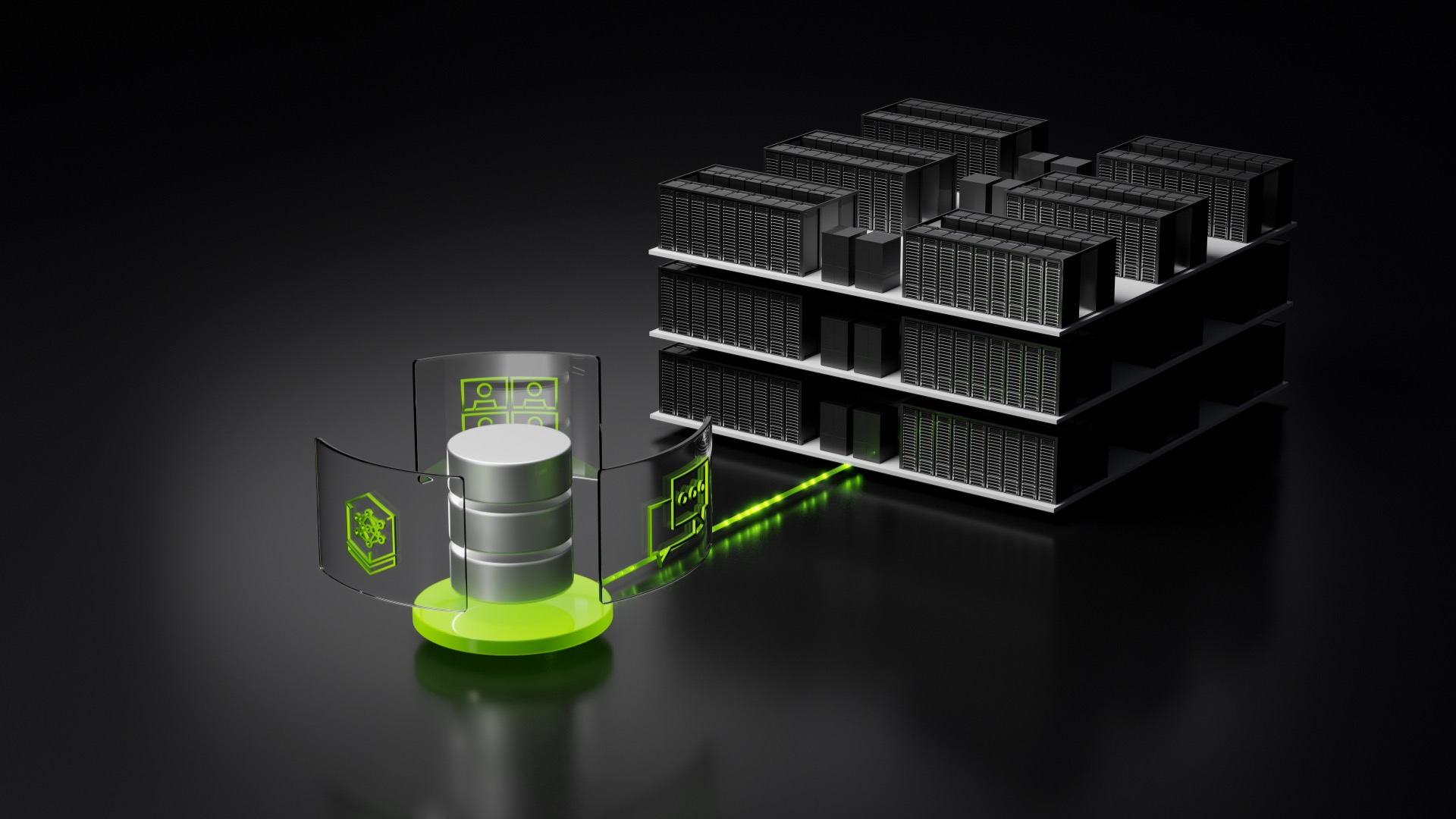
AIがメモリ需要を押し上げる中、ストレージ技術が進化As AI Increases Demands on Memory, Storage Steps Up
匿名の公開いいねです。記事の保存・お気に入りではなく、Featured、Top 3、重要度、掲載順位には影響しません。仕組みとプライバシーAnonymous public likes are reactions, not saved articles or bookmarks. They do not affect Featured, Top 3, importance, or listing order.How it works and privacy
- 急拡大するAIワークロードは巨大なデータセットと長いコンテキストウィンドウを必要とし、システムメモリの限界を超えつつある。
- 単純な容量増加では不十分で、AIファクトリー向けの高効率・高セキュアなストレージソリューションが求められている。
- Surging AI workloads are pushing beyond the limits of system memory, demanding smarter storage solutions rather than simply more capacity.
- Efficient, secure storage architectures are becoming critical infrastructure for AI factories.
本ページの本文と要約は AI による自動生成です。日本語版と英語版は言語ごとに独立して生成されるため、表現や詳しさが異なる場合があります。正確性は元記事 (blogs.nvidia.com) をご確認ください。The body and summaries are AI-generated independently for each language, so wording and detail may differ. Verify accuracy at the original source (blogs.nvidia.com).
要約と収集メタデータに基づく AI 解説。元記事全文の転載・翻訳ではありません。AI explainer based on the summaries and collected metadata, not a copy or translation of the full source article.
生成AIの普及に伴い、モデルが扱うデータ量やコンテキストウィンドウは急速に拡大し、従来のシステムメモリでは処理しきれない規模に達しつつある。NVIDIAは自社ブログで、こうした需要に応えるには単純にストレージ容量を積み増すだけでは不十分であり、AIファクトリー向けの高効率かつ高セキュアなストレージ技術が不可欠になっていると論じている。
背景にあるのは、大規模言語モデル(LLM)や推論処理の高度化だ。長い文脈を保持したまま応答を生成したり、膨大な学習データや検索対象の文書を扱ったりする場面が増え、GPUやCPUに直結するメモリだけでは容量が足りなくなっている。その不足分をストレージ層が補う形で、データを効率よく出し入れする仕組みが重要性を増していると見られる。
ここで問われるのは、単なる大容量化ではなく「使える」データ基盤としての性能だ。NVIDIAは、AIファクトリーから得られる有用で根拠のある知見と、効率的で安全なストレージの組み合わせが求められると強調している。学習や推論の過程で生じる大量の読み書きに耐えつつ、データの機密性や整合性を保つことが、実運用では欠かせない要素となる。
こうした課題は、AIインフラ全体の設計思想とも密接に関わる。近年はGPUと高速メモリ、ストレージ、ネットワークを一体で最適化する動きが業界で広がっており、ストレージ専業ベンダーや半導体メーカーも高速インターフェースやデータ処理のオフロード技術に注力している。メモリとストレージの境界が曖昧になりつつある中で、両者をどう連携させるかが、AI処理の効率とコストを左右する可能性がある。
今回のNVIDIAの発信は、AIの性能向上がGPUの演算能力だけでなく、データを支えるストレージ技術の進化にも依存していることを改めて示すものだ。今後、AIファクトリーの規模拡大が続けば、ストレージはアクセラレーターと並ぶ重要なインフラ要素として位置づけられていくとみられる。
Surging artificial intelligence workloads are pushing beyond the limits of system memory, and the response, according to NVIDIA, is not simply to add more capacity but to rethink how data moves through the entire computing stack. As models grow larger and their context windows expand, storage is emerging as a form of critical infrastructure rather than a passive repository. That shift matters for anyone building or operating large-scale AI systems, because the bottleneck is moving from raw compute toward the pipelines that feed data to processors.
The core problem is scale. Modern AI applications increasingly depend on enormous datasets and long context windows that burst past the confines of a server's memory. When a model needs to reason over more tokens, retrieve relevant documents, or hold larger working sets, the amount of data involved can exceed what fits in high-bandwidth memory attached to a GPU or even in a system's main DRAM. In practice, that forces data to spill over to storage, and how efficiently that spillover happens increasingly determines overall performance.
NVIDIA's framing is that rising needs are not met by simply adding more storage capacity. Terabytes of additional disk do little good if the data cannot reach the accelerators quickly, securely, and in a form the model can use. What is needed instead, the company argues, is useful, grounded insight drawn from what it calls AI factories, alongside efficient and secure storage architectures. The emphasis on grounded insight points toward workflows where models are anchored to verified enterprise data rather than relying solely on parameters learned during training, a pattern that reduces fabrication and keeps outputs tied to authoritative sources.
Several adjacent concepts help explain why storage has become central. Retrieval-augmented generation, or RAG, lets a model pull relevant passages from an external corpus at inference time, which shifts pressure onto the systems that index and serve that corpus, often vector databases sitting on fast storage. Key-value caches, which store intermediate attention states so a model does not recompute them for every token, can grow very large for long conversations and are candidates for offloading to memory tiers beyond the GPU. Each of these techniques trades compute for data movement, making the latency and bandwidth of the storage layer directly visible in user-facing response times.
The memory hierarchy underlying all of this is layered by design. At the top sits high-bandwidth memory, physically close to the GPU and extremely fast but limited in capacity and costly. Below it is system DRAM, then solid-state storage built on NVMe interfaces, and finally larger, slower archival tiers. The engineering challenge is to keep the most relevant data as close to the processor as possible while gracefully handling the far larger volumes that cannot fit. Technologies that create a more direct path between storage and accelerator memory, reducing trips through the CPU, are one way vendors have tried to narrow this gap, and they appear to be a growing area of focus as datasets keep expanding.
Security is the other half of the requirement. As AI factories ingest proprietary and sometimes regulated data, the storage layer becomes a place where confidentiality, integrity, and access control must be enforced without adding so much overhead that throughput collapses. Encryption, isolation between tenants or workloads, and verifiable data provenance are all likely to feature more prominently as these systems move from experimental deployments into production environments handling sensitive information.
The broader industry context is that the term AI factory reflects a view of the data center as a facility that manufactures intelligence, taking in data and producing tokens, predictions, or decisions at scale. In that model, storage is not an afterthought but a coequal partner to compute and networking. The message here is consistent with a wider trend across the sector, where suppliers of memory, drives, and interconnects are all positioning their products around AI demand.
For organizations planning infrastructure, the practical takeaway appears to be that capacity planning alone is insufficient. Matching storage bandwidth, latency, and security features to the specific demands of training and inference is becoming a design decision with real consequences for cost and performance, and one that will likely grow more important as context windows and datasets continue to expand.
ポコとTECHガイドPoko & TECH Guide
ポコと当サイトのTECHガイドが、記事の要約と収集した情報から読みどころを語るAI生成の対話です。Poko and TECH Dashboard's own TECH Guide discuss the article's highlights in an AI-generated conversation based on its summary and collected source details.
- ポコPoko長い「コンテキストウィンドウ」がシステムメモリを超えるって、つまりどういうこと?What does it mean when a long “context window” goes beyond system memory?
- TECHガイドTECH Guide簡単に言うと、コンテキストウィンドウはAIが一度に参照する情報の範囲じゃ。記事によれば、巨大なデータと長い文脈でメモリの限界に近づいておる。Simply put, a context window is the information AI can reference at once. According to the article, huge datasets and longer contexts are pushing system memory toward its limits.
- ポコPokoそれなら、ストレージの容量をどんどん増やせば解決するんじゃないの?Then couldn’t we solve it by just adding more and more storage?
- TECHガイドTECH Guide記事では、容量を増やすだけでは不十分としておる。AIを動かす基盤には、データを効率よく安全に扱えるストレージ構成が重要という話じゃよ。The article says capacity alone isn’t enough. Infrastructure running AI needs storage architectures that handle data efficiently and securely.
- ポコPokoなるほど!AIのデータが増えるほど、ストレージは大きさだけでなく効率と安全性も大事になるんだね。Got it! As AI data grows, storage needs more than size—it also needs efficiency and security.
- TECHガイドTECH Guideその通りじゃ。今後の見どころは、AIファクトリー向けに効率と安全性をどう両立するかじゃな。Exactly. The key thing to watch is how storage for AI factories balances efficiency with security.