HomeIndustry & PolicyGoogle、統合型エンコーダーレスマルチモーダルモデル「Gemma 4 12B」を発表
Introducing Gemma 4 12B: a unified, encoder-free multimodal model
Industry & Policy 🔥 HOT ⚠ 古い情報の可能性

Google、統合型エンコーダーレスマルチモーダルモデル「Gemma 4 12B」を発表 Introducing Gemma 4.12B: a unified, encoder-free multimodal model

元記事を読む 古い情報の可能性
AI 3 行サマリ
  • Googleは、ラップトップ上で高性能なマルチモーダルAIを実現するオープンモデル「Gemma 4 12B」を発表した。
  • エンコーダーを持たない統合アーキテクチャを採用し、テキストと画像を単一モデルで処理できる点が特徴だ。
English summary
  • An overview of Gemma 4 12B, a model designed to bring high-performance multimodal intelligence directly to your laptop.

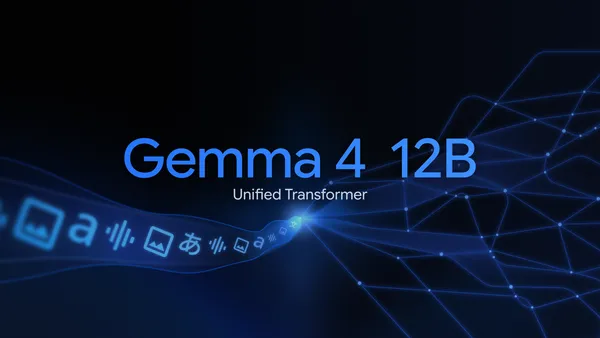
Googleは2026年6月、オープンモデルシリーズ「Gemma」の最新作となる「Gemma 4 12B」を発表した。最大の特徴は、画像エンコーダーを別途持たない「エンコーダーレス」の統合アーキテクチャであり、テキストと画像をひとつのモデルで扱えるマルチモーダル設計を採用している点にある。

従来のマルチモーダルモデルの多くは、画像を処理するための専用エンコーダー(例:Vision Transformerなど)をテキストモデルと組み合わせる構成をとる。これに対しGemma 4 12Bは、エンコーダーを統合することでアーキテクチャをシンプルに保ちつつ、高い推論性能を実現しようとしている。パラメータ数は12Bと比較的コンパクトであり、ラップトップなどコンシューマー向けハードウェアでの動作を主眼に設計されていると見られる。

GemmaシリーズはGoogleが継続的に投資するオープンモデル戦略の中核であり、開発者や研究者がGoogle Cloud以外の環境でも自由に利用できることを重視している。2024年に登場した初代Gemmaから始まり、Gemma 2、そして今回のGemma 4へとアーキテクチャの改良が続いており、各世代で性能と効率性の向上が図られてきた。

Googleは、ラップトップ上で高性能なマルチモーダルAIを実現するオープンモデル「Gemma 4 12B」を発表した。
📰 Industry & Policy · 本記事のポイント

業界全体に目を向けると、エンコーダーレスのマルチモーダルアーキテクチャはMeta、Mistral、Appleなど複数の研究グループでも注目されているアプローチだ。画像とテキストを共通のトークン空間で扱うことで、訓練・推論パイプラインが統一され、将来的な拡張性も高まる可能性がある。一方、エンコーダー分離型と比べてどちらが実用上有利かは、タスクやハードウェア環境によって異なるため、引き続き研究が進む領域でもある。

Gemma 4 12Bの登場は、強力なマルチモーダルAIをクラウドに依存せずローカルで動かしたいという開発者ニーズに応えるものであり、オープンモデルエコシステムのさらなる拡充につながると期待される。

Google announced Gemma 4 12B in June 2026, the latest entry in its open-model Gemma series. The headline feature is a unified, encoder-free architecture — meaning the model handles both text and images within a single network, rather than pairing a language model with a separate vision encoder like a Vision Transformer.

Most multimodal models today rely on a modular design: a dedicated image encoder extracts visual features, which are then passed to a language model for reasoning. Gemma 4 12B collapses this pipeline into one, simplifying the architecture while aiming to preserve — or improve — overall capability. At 12 billion parameters, the model is explicitly designed to run on consumer hardware, with laptops cited as a primary deployment target. This positions it as a practical tool for developers who want powerful multimodal inference without a cloud dependency.

The Gemma family has been Google's most visible open-model initiative since its debut in early 2024. Each generation — Gemma, Gemma 2, and now Gemma 4 — has brought architectural refinements alongside efficiency gains. The series sits alongside Google's proprietary Gemini lineup but occupies a different role: enabling on-device and self-hosted deployments, often through integrations with frameworks like Hugging Face Transformers, llama.cpp, and Google's own Keras.

Encoder-free multimodal design is an active area of exploration across the AI industry. Researchers at Meta, Mistral, and Apple have all published work on approaches that unify vision and language into a shared token space. The theoretical appeal is clear: a single training objective, a simpler inference stack, and potentially better cross-modal reasoning. Whether this approach outperforms encoder-coupled designs in practice tends to depend heavily on the specific task and hardware — making it an open research question rather than a settled debate.

For the developer community, Gemma 4 12B arrives at a moment of growing interest in local AI deployments. Edge inference, privacy-sensitive applications, and offline scenarios are all driving demand for capable models that don't require a network call. A 12B multimodal model that can handle image and text inputs on a laptop could open up a meaningful new class of applications — from document analysis to visual assistants — for developers who previously had to rely on API-gated models.

Whether Gemma 4 12B lives up to its architectural ambitions will become clearer as independent benchmarks and community evaluations emerge. But as a statement of intent, it underscores Google's continued commitment to competitive open-model releases alongside its cloud-centric Gemini offerings.

  • SourceGoogle Keyword BlogT2
  • Source Avg ★ 2.2
  • Typeブログ
  • Importance ★ 重要 (top 25% in Industry & Policy)
  • Half-life ⏱️ 短命 (ニュース)
  • LangEN
  • Collected2026/06/07 13:00

本ページの本文・要約は AI による自動生成です。正確性は元記事 (blog.google) をご確認ください。

📰 Industry & Policy の他の記事 もっと見る →

URL をコピーしました