LookerのセマンティックレイヤーがGemini Enterpriseのデータを統制しユーザーの信頼を確保Looker’s semantic layer governs Gemini Enterprise data for user trust
匿名の公開いいねです。記事の保存・お気に入りではなく、Featured、Top 3、重要度、掲載順位には影響しません。仕組みとプライバシーAnonymous public likes are reactions, not saved articles or bookmarks. They do not affect Featured, Top 3, importance, or listing order.How it works and privacy
LookerのガバナンスされたセマンティックレイヤーがGemini Enterpriseと統合され、企業データへの自然言語クエリの精度を高めAIハルシネーションを抑制する。
Looker's governed semantic layer now integrates with Gemini Enterprise, providing structured context to LLMs so employees get consistent, trustworthy answers when querying enterprise data through natural language.
本ページの本文と要約は AI による自動生成です。日本語版と英語版は言語ごとに独立して生成されるため、表現や詳しさが異なる場合があります。正確性は元記事 (cloud.google.com) をご確認ください。The body and summaries are AI-generated independently for each language, so wording and detail may differ. Verify accuracy at the original source (cloud.google.com).
要約と収集メタデータに基づく AI 解説。元記事全文の転載・翻訳ではありません。AI explainer based on the summaries and collected metadata, not a copy or translation of the full source article.
Googleは、BIプラットフォームLookerのガバナンスされたセマンティックレイヤーを、生成AIアシスタント「Gemini Enterprise」と統合したと発表した。自然言語で企業データを問い合わせた際の回答精度を高め、AIによるハルシネーション(誤情報の生成)を抑えることを狙う取り組みだ。
背景には、AIエージェントを大規模に展開する企業が直面する「構造化データと非構造化データの断絶」がある。大規模言語モデル(LLM)は文書やメール、PDFといったテキストの解釈を得意とする一方、生のデータベースを提示されると扱いに苦労しやすい。また、一般的な自然言語からSQLへの変換(NL2SQL)モデルは、データベースのスキーマ同士がどう結び付くかを推測で補うことが多く、その結果としてクエリが不安定になったり、指標が一貫しなかったり、ユーザーの信頼を損なうハルシネーションを招いたりする課題があった。
Gemini Enterpriseは、直感的なチャット画面を通じて、職場におけるAI利用の単一の入り口として機能し、Googleのモデルを従業員に届ける存在と位置付けられている。今回の統合により、Lookerのセマンティックレイヤーが構造化データにおける信頼できる土台となる。Lookerでは指標やデータ間の関係をあらかじめ定義しており、この定義済みの文脈をLLMに与えることで、モデルが推測に頼る余地を減らし、一貫性のある回答を導きやすくなると見られる。
セマンティックレイヤーは、指標の定義やデータの意味を一元管理し、部門ごとに数字がばらつく事態を防ぐ仕組みとして近年注目を集めている。データガバナンスを重視する企業では、AIの回答が正しい定義に基づくことが導入の前提になりつつあり、生成AIと既存のBI資産をつなぐ動きは各社で広がっている。今回の統合は、こうした潮流の中で、信頼できるセルフサービス分析を従業員に広げる試みと言える。実際の効果は各企業のデータ整備状況にも左右される可能性があり、導入時にはセマンティックレイヤー側の定義品質が引き続き重要になるとみられる。
Google Cloud has outlined how Looker's governed semantic layer now integrates with Gemini Enterprise, serving as what it describes as a trusted foundation for structured data. The integration matters because it addresses one of the more stubborn problems facing organizations that want to deploy AI agents at scale: the divide between the unstructured content that language models handle well and the structured databases that run day-to-day business operations.
As Google Cloud describes it, large language models excel at parsing text documents, emails, and PDFs, but they can falter when handed a raw enterprise database. Standard natural-language-to-SQL (NL2SQL) approaches often try to infer how database schemas fit together, effectively guessing at the relationships between tables and columns. That guesswork can yield unpredictable queries, inconsistent metrics, and hallucinations that erode user trust in the results.
The semantic layer is intended to close that gap by supplying explicit context rather than leaving a model to improvise. In Looker, business logic is expressed through a modeling language called LookML, which codifies metric definitions, table relationships, and the rules governing how data should be joined and aggregated. When a definition such as "revenue" or "active customer" lives in that governed layer, every query resolves against the same agreed-upon logic, so two people asking the same question should receive the same answer.
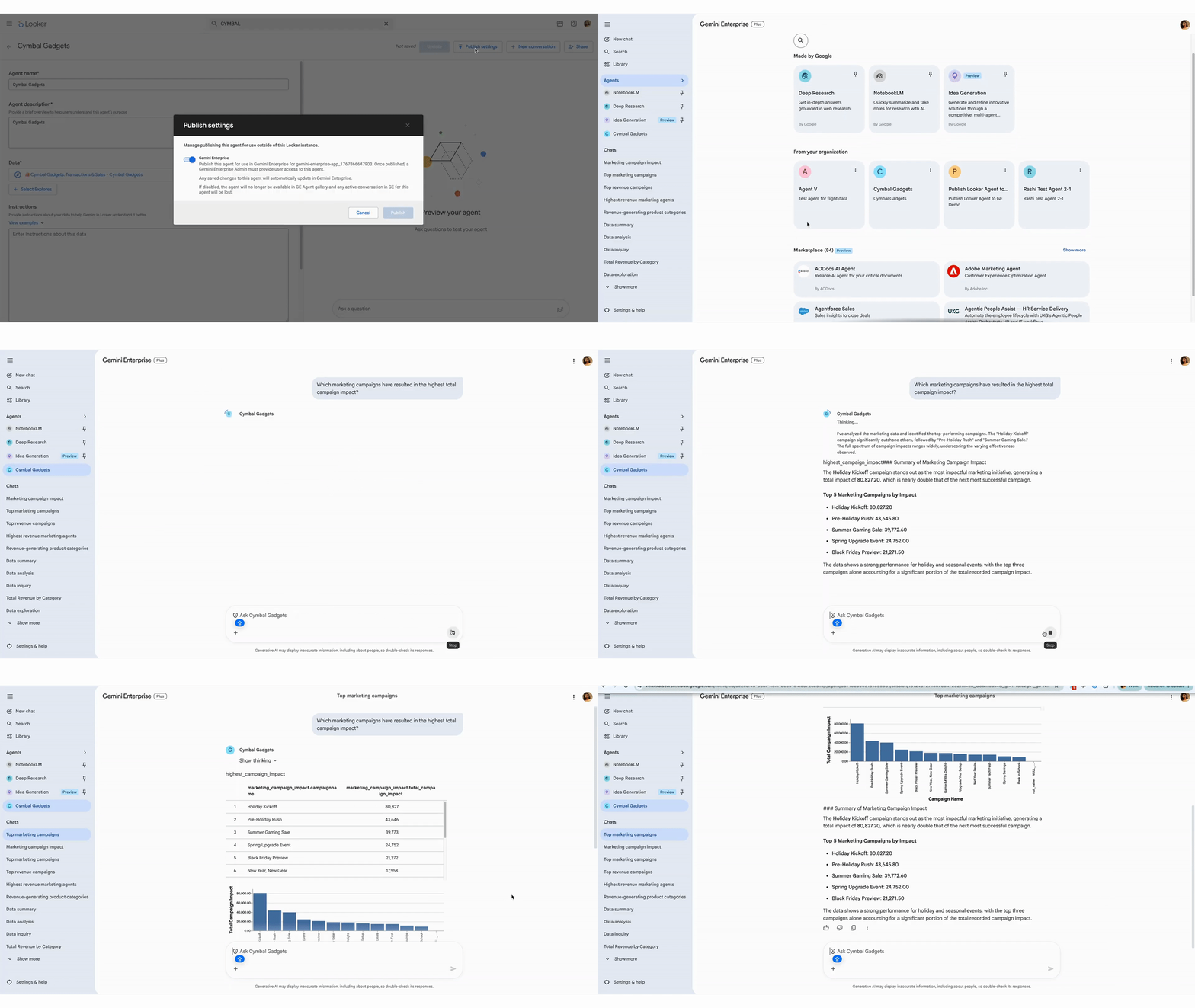
Gemini Enterprise, for its part, is positioned as an intuitive chat interface that brings Google's AI to every employee and acts as a single front door for AI in the workplace. By routing questions about structured data through Looker's semantic layer, the integration aims to enable trusted self-service: employees can ask questions in plain language and get answers grounded in governed definitions rather than ad hoc SQL generated on the fly. This appears designed to preserve the consistency and access controls that data teams already maintain in Looker.
The distinction between the two data types helps explain why this pairing is significant. Unstructured retrieval approaches, where a model pulls relevant passages from documents, have matured quickly. Structured data is harder because correctness depends not just on locating the right numbers but on applying the correct business logic, filters, and joins. A model that misinterprets a schema can produce an answer that looks confident and precise yet is quantitatively wrong, which is often more damaging than an obvious error.
The concept of a semantic layer is not unique to Looker. Tools such as dbt Labs' semantic layer, Cube, and AtScale have promoted similar ideas, and the broader industry has increasingly framed the semantic layer as a control point for feeding trustworthy structured context to LLMs. Google acquired Looker in 2020, and the platform has since been woven more deeply into Google Cloud's analytics stack alongside BigQuery and other services. Grounding Gemini Enterprise in that governed layer is consistent with a wider strategy of connecting Google's models to enterprise systems of record.
For organizations, the practical implication is that existing governance work in Looker is likely to carry over into AI-driven querying. Metric definitions, permissions, and row-level controls maintained by data teams can act as guardrails when the same data is accessed through a conversational interface. That could reduce the risk that self-service AI produces figures contradicting official dashboards or reports, a common source of friction when different tools calculate the same metric differently.
Several details remain worth watching as the capability rolls out. Google Cloud's framing emphasizes trust and consistency, but the quality of results will still depend heavily on how thoroughly an organization has modeled its data in LookML, since gaps or errors in that layer would propagate into answers. The announcement also sits within a competitive field where other vendors are pursuing comparable governed text-to-data features. Even so, the underlying premise is straightforward: constraining a language model with a curated semantic layer is presented as a more reliable path than allowing it to guess at database structure, and it reflects a broader shift toward treating governance as a prerequisite for enterprise AI rather than an afterthought.
ポコとTECHガイドPoko & TECH Guide
ポコと当サイトのTECHガイドが、記事の要約と収集した情報から読みどころを語るAI生成の対話です。Poko and TECH Dashboard's own TECH Guide discuss the article's highlights in an AI-generated conversation based on its summary and collected source details.
- ポコPokoセマンティックレイヤーって何? Gemini Enterpriseとつながると、何が変わるの?What’s a semantic layer? What changes when it connects with Gemini Enterprise?
- TECHガイドTECH Guide簡単に言うと、データの意味や関係を整理する層じゃな。記事によれば、企業の構造化データをLLMが理解する土台になるそうじゃよ。Simply put, it organizes what data means and how it relates. According to the article, it gives LLMs a trusted foundation for understanding structured enterprise data.
- ポコPokoそれって何が嬉しいの? 生のデータベースをAIに読ませるのとは違う?Why is that useful? How is it different from letting AI read a raw database?
- TECHガイドTECH Guide記事では、生のデータやNL2SQLは構造を推測し、不安定な問い合わせや指標の不一致を招く場合があるという。整理された文脈で、回答の精度を高め幻覚を抑えるのじゃな。The article says raw data and NL2SQL may guess how schemas connect, causing unpredictable queries and inconsistent metrics. Structured context can improve answer accuracy and curb hallucinations.
- ポコPokoなるほど! データの意味を先にそろえて、社員が自然な言葉で聞いても一貫した答えを得やすくするんだね。Got it! Aligning the data’s meaning first makes consistent answers more likely when employees ask questions in everyday language.
- TECHガイドTECH Guideその理解でよいぞ。記事によれば、AIを広く使う企業では、構造化データへの回答をどこまで信頼できるものにできるかが大切な点じゃよ。Exactly. According to the article, a key issue for organizations deploying AI broadly is how trustworthy answers based on structured data can become.